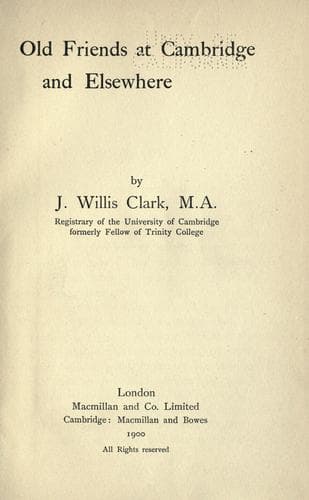
Old Friends at Cambridge and ElsewhereClark, John Willis
History
Old Friends at Cambridge and Elsewhere
Clark, John Willis
University of Cambridge -- History
For his prose works, or at least for some of them, we predict a very
different fate. We do not like even to think of an age that will refuse
to admire the charming style, the real dramatic power, the exquisite
tact, and the fine taste which distinguish his _Life of Keats_, and his
_Monographs_, to which we have already alluded. Other essays, probably
of equal merit, lie scattered in Reviews and Magazines. We hope that
before long we may see the best of these collected together. Such a
series, which would cover a period of nearly sixty years, would form a
most important chapter in the history of English literature.
Besides his reputation as a writer, Milnes occupied an unique position
towards the world of letters, which it is not quite easy to define. It
is not enough to say that he was a Mæcenas, though he knew and
entertained the whole literary community both in London and at Fryston—a
house which, as Thackeray said, ‘combined all the graces of the château
and the tavern’; or that he was always ready to lend a helping hand to
those in distress, though he spent a fortune in generously and
delicately assisting others. His peculiar characteristics were a rare
gift in detecting merit, and an untiring energy in bringing it out, and
setting it in a position where it could bloom and flourish and be
recognized by other people. In effecting this he spared no pains, and
shrank from no annoyance. Often, indeed, he must have risked his own
popularity by his importunity for favours to be conferred on others. Mr
Reid describes at length the amusing scene between him and Sir Robert
Peel, when he solicited and obtained pensions for Tennyson and Sheridan
Knowles, of neither of whom the Minister had ever heard; and to Milnes
must also be allowed the credit of having been the first, or nearly the
first, to bring into prominent recognition the merits of Mr John
Forster. He possessed, too, in a very high degree, the gift of sympathy,
and, as a consequence, of influence. ‘Ever since I knew you,’ said his
friend Macarthy, ‘you have been the chief person in my life; a friend
and brother and confessor—the end and aim of all my actions and hopes’;
and Robert Browning, in a long and most interesting letter, written to
ask Milnes to use his interest to get him appointed secretary to the
minister whom England, as he then believed, ‘must send before the year
ends to this fine fellow, Pio Nono[87],’ admits that his own interest in
Italy was due in the first instance to Milnes’s influence. ‘One gets
excited,’ he says, ‘at least here on the spot, by this tiptoe strained
expectation of poor dear Italy, and yet, if I had not known you, I
believe I should have looked on with other bystanders.’ We have said
that he was charitable; but to say this is to give an imperfect idea of
the efforts he would make for literary men in difficulties. When Hood
was in distress he found that he ‘preferred to receive assistance in the
Public-domain text, read in full here on John Shaqi.
Reviews
Reviews
No reviews yet
Be the first to share your thoughts on this work.
Elsewhere in the archive
Join the Discussion
Join the discussion
Sign in to leave a comment or review.
Sign InorCreate an account