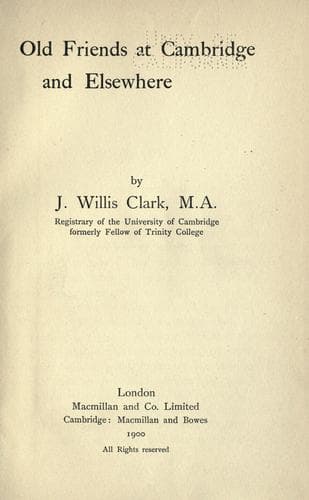
Old Friends at Cambridge and ElsewhereClark, John Willis
History
Old Friends at Cambridge and Elsewhere
Clark, John Willis
University of Cambridge -- History
Up to this time—the year 1860—he had never turned his attention to
Oriental literature, and very likely had never seen an Oriental
character. The friend whose reminiscences we have quoted more than once
already says that he remembers ‘going one morning into his bedroom (he
was a very late riser) and finding him looking at some Arabic
characters. They interested him; he liked the look of them; it was an
improvement on shorthand; he would find it all out; and so he did!’ He
set to work without delay to find somebody he could talk to about his
new fancy, and, as the supply of Oriental scholars is necessarily
limited even at one of the Universities, he was led at once to the only
two persons competent to instruct him—the Rev. George Skinner, and a
Mohammedan named Syed Abdullah. The former was a Master of Arts of the
University, who had published a translation of the Psalms; the latter
was a native of Oudh, who had resided in England since 1851, and who
about this time came to Cambridge to prepare students for the Civil
Service of India. Under the guidance of these gentlemen, Palmer plunged
into Oriental languages with the same enthusiasm with which he had
followed the various pursuits we have mentioned above. There was this
difference, however, between the new love and the old; there was no
turning back; the day of transient fancies was over; that of serious
work had begun. His ardour now knew no abatement; he is said to have
worked at this time eighteen hours a day. This may well be doubted; but
without pressing such a statement too closely, we may admit that he gave
himself up to his new studies with unwonted perseverance, and that his
progress was rapid. Mr Skinner used to take him out for walks in the
country, and discourse to him on Hebrew grammar. Hebrew, however, was a
language which did not attract him greatly, and in after years he used
to say that he did not know it. Syed Abdullah gave him more regular and
systematic instruction in Urdú, Persian, and Arabic. Palmer was
‘constantly writing prose and verse exercises for him.’ They became
intimate friends; and it was probably through his representations that
Palmer was allowed to give up all thoughts of resuming work as a clerk,
and to take up Oriental languages and literature as a profession.
Through him, too, he was introduced to the Nawab Ikbal ud Dawlah, son of
the late Rajah of Oudh, who took a very warm interest in Palmer’s
studies, allowed him to live in his house when he pleased, and gave him
the assistance of two able native instructors. Next he struck up a
friendship with a Bengalee gentleman named Bazlurrahim, with whom he
spent some time, composing incessantly under his supervision in Persian
and Urdú. Besides these he was on terms of intimacy with other Orientals
resident at that time in England, and also with Professor Mir Aulad Ali,
of Trinity College, Dublin, ‘who was constantly his adviser, critic,
teacher, friend, and sympathizer.’ Hence, as Mr Besant points out, we
Public-domain text, read in full here on John Shaqi.
Reviews
Reviews
No reviews yet
Be the first to share your thoughts on this work.
Elsewhere in the archive
Join the Discussion
Join the discussion
Sign in to leave a comment or review.
Sign InorCreate an account