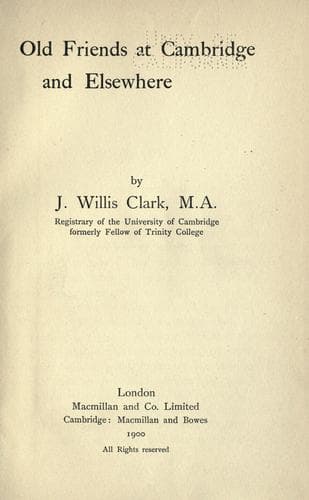
Old Friends at Cambridge and ElsewhereClark, John Willis
History
Old Friends at Cambridge and Elsewhere
Clark, John Willis
University of Cambridge -- History
The results of this expedition will be found in _The Desert of the
Exodus_[93], a delightful book, in which Palmer has narrated in a
pleasing style the daily doings of the surveyors, and the conclusions at
which they arrived. His own proceedings are kept modestly in the
background; but a careful reader will soon discover that, in addition to
his appointed task as collector of folk-lore, he did his full share of
topographical investigation, in which he evidently took a keen and
growing interest, all the more remarkable as he could have had but
little previous preparation for it. A detailed analysis of the results
achieved would occupy far more space than we have at our disposal. We
will only mention that the investigations of the expedition ‘materially
confirmed and elucidated the history of the Exodus’; that objections
founded on the supposed incapacity of the peninsula to accommodate so
large a host as that of Israel were disposed of by pointing out abundant
traces of ancient fertility; that the claims of Jebel Musa to be the
true Sinai were vindicated by a comparison of its natural features with
the Bible narrative, and by the collection of Arab and Mohammedan
traditions; and, lastly, that the site of Kibroth Hattaavah was
determined, partly on geographical grounds, partly on the traditions
still current among the Towarah Bedouin, whose language Palmer mastered,
and of whose manners and customs he has drawn up a very full and
interesting account. The intimate acquaintance which he thus formed with
one of these tribes stood him in good stead in the following year, when
he took a far more responsible journey. The ease with which he spoke the
Arab language was, however, one of the least of his many gifts: he
thoroughly understood Arab character, and was generally successful, not
merely in making the natives do what he wanted, but, what is far more
wonderful, in making them speak the truth to him. He thus sums up his
method of dealing with them:
‘An Arab is a bad actor, and with but a very little practice you may
infallibly detect him in a lie; when directly accused of it, he is
astonished at your, to him, incomprehensible sagacity, and at once gives
up the game. By keeping this fact constantly in view, and at the same
time endeavouring to win their confidence and respect, I have every
reason to believe that the Bedawín gave us throughout a correct account
of their country and its nomenclature.
‘When once an Arab has ceased to regard you with suspicion, you may
surprise a piece of information out of him at any moment; and if you
repeat it to him a short time afterwards, he forgets in nine cases out
of ten that he has himself been your authority, and should the
information be incorrect will flatly contradict you and set you right,
while if it be authentic he is puzzled at your possessing a knowledge of
the facts, and deems it useless to withhold from you anything
further[94].’
Public-domain text, read in full here on John Shaqi.
Reviews
Reviews
No reviews yet
Be the first to share your thoughts on this work.
Elsewhere in the archive
Join the Discussion
Join the discussion
Sign in to leave a comment or review.
Sign InorCreate an account