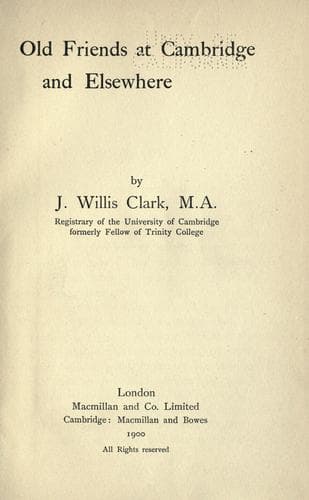
Old Friends at Cambridge and ElsewhereClark, John Willis
History
Old Friends at Cambridge and Elsewhere
Clark, John Willis
University of Cambridge -- History
The survey of Sinai had been completed but a few months when Palmer left
England again, for a second journey of exploration. It is evident that
he must have taken a more prominent part in the management of the first
expedition than the precise terms of his engagement with the explorers
would have led us to expect, and that he had thoroughly satisfied those
responsible for it, for this second expedition was practically entrusted
to him to arrange as he pleased. He was instructed in general terms to
clear up, first, certain disputed points in the topography of Sinai;
next, to examine the country between the Sinaitic Peninsula and the
Promised Land—the ‘Desert of the Wanderings’; and, lastly, to search for
inscriptions in Moab. He determined to take with him a single companion
only, Mr Charles Tyrwhitt-Drake, of Trinity College, Cambridge, who had
had already some experience of the East, and who proved himself in every
way to be the man of men for rough journeys in unknown lands; to travel
on foot, without dragoman, servant, or escort; and to take no more
baggage than four camels could carry. The two friends started from Suez
on December 16, 1869, and reached Jerusalem in excellent health and
spirits on February 26, 1870. They had performed a feat of which anybody
might well be proud. They had traversed ‘the great and terrible desert,’
the Desert of El Tih, and the Negeb, or ‘south country’ of Palestine,
exactly as they had proposed to do—on foot, with no attendants except
the owners of the baggage-camels. They had walked nearly 600 miles; but
this fact, though it says much for their endurance, gives but little
idea of the real fatigues of such a journey. The mental strain must have
been far more exhausting than the physical fatigue. They were not
tourists, but explorers, whose duty it was to observe carefully, to
record their observations on the spot, to make plans and sketches, and
to collect such information as could be extracted from the inhabitants.
These various pursuits—in addition to their domestic arrangements—had to
be carried on in the midst of an Arab population always suspicious, and
sometimes openly hostile, who worried them from daybreak until far into
the night, and against whom their only weapons were incessant
watchfulness, tact, and good humour. Readers of Palmer’s narrative will
not be surprised to find him hinting, not obscurely, that the only way
to solve the ‘Bedouin question’ is to adopt what was called a few years
afterwards, with reference to another not wholly dissimilar race, ‘the
bag and baggage policy.’ This deliberate opinion, expressed by one who
knew the Arabs well, and who had obtained singular influence over them,
is worthy of careful attention, as, indeed, are all the chapters in the
second part of _The Desert of the Exodus_, where this journey is fully
described and illustrated. After reading that narrative no one can be
surprised that the mission which ended so triumphantly and so fatally
Public-domain text, read in full here on John Shaqi.
Reviews
Reviews
No reviews yet
Be the first to share your thoughts on this work.
Elsewhere in the archive
Join the Discussion
Join the discussion
Sign in to leave a comment or review.
Sign InorCreate an account