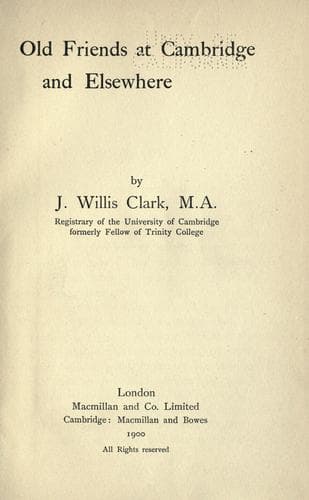
Old Friends at Cambridge and ElsewhereClark, John Willis
History
Old Friends at Cambridge and Elsewhere
Clark, John Willis
University of Cambridge -- History
But, though there was no inscription to bring home as visible evidence
of what had been done, the expedition was not barren of results. In the
first place, the possibility of exploring the little-known parts of
Palestine at a comparatively trifling cost had been demonstrated; and,
secondly, numerous sites had been discovered where further research
would probably yield information of the greatest value. It is a
misfortune that Palmer was not able in after years to give undivided
attention to these interesting problems of Biblical topography. Unless
we are much mistaken, he would have made a revolution in many of them,
and notably in the architectural history of the city of Jerusalem, upon
which he did throw new light from an unexpected quarter—the Arab
historians. He would, in fact, have pursued for the Temple area at
Jerusalem the method which Professor Willis pursued so successfully for
some of our own cathedrals; he would have marshalled in chronological
order the notices of the Arab works there; and then, by comparing the
historical evidence with the existing structures, have assigned their
respective dates with certainty to each of them.
Palmer returned to England in the autumn of 1870, and soon afterwards
became a candidate for the Professorship of Arabic in the University of
Cambridge. He was unsuccessful, and we should have contented ourselves
with recording the fact without comment, had not Mr Besant stated the
whole question in a way reflecting so unfavourably on the electors, and
through them on the University, that we feel compelled to investigate
the circumstances in detail. This is what he says:
‘In the same year Palmer experienced what one is fully justified in
calling the most cruel blow ever dealt to him, and one which he never
forgot or forgave.
‘The vacancy of the Professorship of Arabic in 1871 seemed to give him
at last the chance which he had been expecting.... He became a candidate
for the vacant post; the place in fact _belonged to him_; it was his
already by a right which it is truly wonderful could have been contested
by any—the right of Conquest. The electors were the Heads of the
colleges.
Public-domain text, read in full here on John Shaqi.
Reviews
Reviews
No reviews yet
Be the first to share your thoughts on this work.
Elsewhere in the archive
Join the Discussion
Join the discussion
Sign in to leave a comment or review.
Sign InorCreate an account