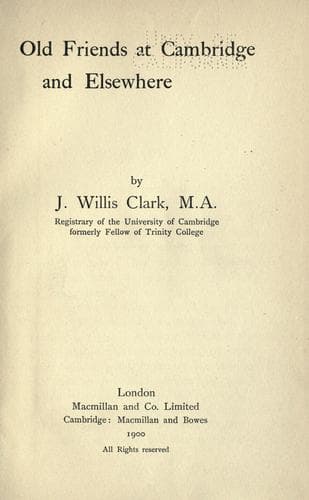
Old Friends at Cambridge and ElsewhereClark, John Willis
History
Old Friends at Cambridge and Elsewhere
Clark, John Willis
University of Cambridge -- History
‘Consider the position: Palmer by this time was a man known all over the
world of Oriental scholarship; he was not a single untried student and
man of books; he had proved his powers in the most practical of all
ways, viz. by relying on his knowledge of the language for safety on a
dangerous expedition; he had written, and written wonderfully well, a
great quantity of things in Persian, Urdú, and Arabic; he was known to
everybody who knew anything at all about the subject; he had been
greatly talked about by those who did not; he was a graduate of the
University and Fellow of S. John’s, an honour which, as was well known,
he received solely for his attainments in Oriental languages; he had a
great many friends who were ready to testify, and had already testified,
in the strongest terms, to his extraordinary knowledge; he was, in fact,
the only Cambridge man who could, with any show of fairness justice at
all, be elected. He was also young, and full of strength and enthusiasm;
if Persian and Arabic lectures and Oriental studies could be made useful
or attractive at the University, he would make them so. What follows
seems incredible.
‘On the other hand, the electing body consisted, as stated above, of the
Heads of colleges. It is in the nature of things that the Heads, who are
mostly men advanced in years, who have spent all their lives at the
University, should retain whatever old prejudices, traditions, and
ancient manner of regarding things, may be still surviving. There
were—it seems childish to advance this statement seriously, and yet I
have no doubt it is true and correct—two prejudices against which Palmer
had then to contend. The first was the more serious. It was at that
time, even more than it is now, the custom at Cambridge to judge the
abilities of every man entirely with regard to his place in one of the
two old Triposes; and this without the least respect or consideration
for any other attainments, or accomplishments, or learning. Darwin, for
instance, whose name does not occur in the Honour list at all, never
received from his college the slightest mark of respect until his death.
Long after he had become the greatest scientific man in Europe the
question would have been asked—I have no doubt it was often asked—what
degree he took. Palmer’s name did occur in the Classical Tripos—but
alas! in the third class. Was it possible, was it probable, that a
third-class man could be a person worthy of consideration at all?
Third-class men are good enough for assistant-masters in small schools,
for curacies, or for any other branch of labour which can be performed
without much intellect. But a third-class man must never, under any
circumstances, consider that he has a right to learn anything or to
claim distinction as a scholar. I put the case strongly; but there is no
Cambridge man who will deny the fact that, in whatever branch of
learning distinction be subsequently attained, the memory of a second or
third class is always prejudicial.
Public-domain text, read in full here on John Shaqi.
Reviews
Reviews
No reviews yet
Be the first to share your thoughts on this work.
Elsewhere in the archive
Join the Discussion
Join the discussion
Sign in to leave a comment or review.
Sign InorCreate an account