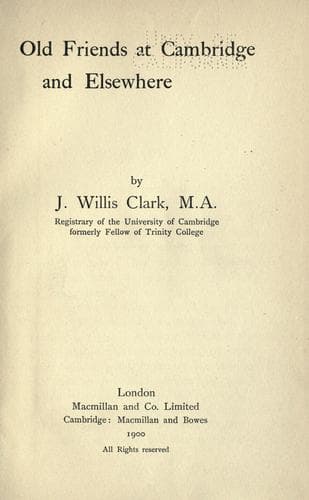
Old Friends at Cambridge and ElsewhereClark, John Willis
History
Old Friends at Cambridge and Elsewhere
Clark, John Willis
University of Cambridge -- History
How familiar he was with Arabic and Persian is shown by
the curious fact that whenever he was under strong emotion he would
plunge abruptly into one or other language, sometimes writing a whole
letter in it, sometimes only a sentence or two, or a few verses. Besides
these Oriental ‘trifles’ as he would probably have called them, we find
continual contributions to English periodical literature, and three
volumes of poetry: _English Gipsy Songs in Romany_ (1875); the _Song of
the Reed, and other Pieces_ (1876); and _Lyrical Songs_, &c. by John
Ludwig Runeberg (1878). In the first of these he collaborated with Mr
Leland, whom we mentioned before, and Miss Janet Tuckey; and in the last
with Mr Magnusson; but the second is entirely his own. We regret that we
cannot find room for a specimen of these graceful verses. Those who have
leisure to look into the _Song of the Reed_, or the translation of
Zoheir, will find themselves introduced to a new literature by one who,
if not a poet, was unquestionably, as Mr Besant says, a versifier of a
high order, and in the very front rank of translators.
We have said that most of this work—were it grave or gay, it mattered
not—had to be got through in the midst of serious anxieties. Mrs
Palmer’s health began to fail before they had been married long, and it
soon became evident that her lungs were affected. It was necessary that
she should leave Cambridge. In the spring of 1876, Wales was tried, with
results which were so reassuring that it was decided to complete her
cure (as it was then believed) by a winter in Paris. There, however, she
got worse instead of better, and early in the following year her husband
began to realize that she would die. In the autumn of 1877, they
returned home to try Wales once more, and then, as a last resource,
Bournemouth. There, in the summer of 1878, Mrs Palmer died. The expenses
of so long an illness, added to journeyings to and fro, and the cost of
keeping up two establishments (for he was obliged to continue his
Cambridge lectures all the while), crippled his resources, and produced
embarrassments from which he never became wholly free. His own health,
too, never strong, gave way under his fatigues and worries, and he
became only not quite so ill as his wife. Yet he never complained; never
said a word about his troubles to any of his friends. Those who were
most with him at this dreary time have recorded that he always met them
with a smiling face, and went about his work as calmly as if he had been
well and happy.
Public-domain text, read in full here on John Shaqi.
Reviews
Reviews
No reviews yet
Be the first to share your thoughts on this work.
Elsewhere in the archive
Join the Discussion
Join the discussion
Sign in to leave a comment or review.
Sign InorCreate an account