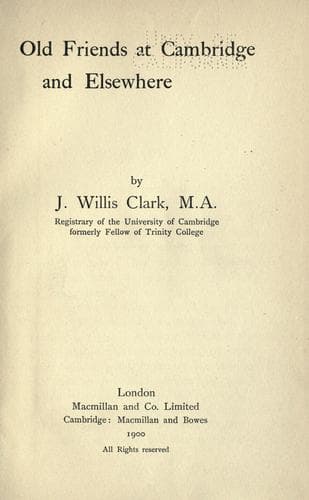
Old Friends at Cambridge and ElsewhereClark, John Willis
History
Old Friends at Cambridge and Elsewhere
Clark, John Willis
University of Cambridge -- History
It is pleasant to be able to record that the happiness which had been so
long delayed came at last. In about a year after his wife’s death he
married again. His choice was fortunate, and for the last three years of
his life he was able to enjoy that greatest of all luxuries—a thoroughly
happy home. He stood sorely in need of such consolation, for in other
directions he had plenty to distress and worry him. His pecuniary
difficulties pressed upon him as hardly as ever, and his relations with
the University began to be somewhat strained. He had had the
mortification of seeing Professor Wright’s salary raised to £500 a year,
with no hint of any corresponding proposition being made for him[101];
and when the Commissioners promulgated their scheme his office was not
included in it, a suggestion for raising his salary which had been made
by the Board of Oriental Studies being wholly disregarded by them.
Moreover, the undertaking to deliver three courses of lectures in each
year turned out to be infinitely more laborious than he had expected.
Candidates for the Indian Civil Service increased in number; and the
pupils of any given term were pretty sure to want to go on with their
work in the next, when he was teaching a different language, so that he
was compelled in practice to give, not one, but two, or even three,
courses in each term. Moreover, the elementary nature of much of this
instruction—the ‘teaching boys the Persian alphabet,’ as he called
it—became every year more and more irksome. We are not surprised that he
got disgusted with the University; but at the same time we cannot agree
with Mr Besant that the University was wholly to blame. They were in no
wise responsible for the conduct of the Commissioners; in fact, all that
could be done to make them take a different view was done. Had Palmer
resided continuously in the University, and pressed his own claims,
things might have been very different. But this he had been unable to
do, for reasons which, as we have seen, were beyond his own control, and
for which, therefore, he is not to be blamed; but the fact cannot be
denied that for some years he had been practically non-resident. There
was also another cause which has to be taken into consideration—his own
disposition. The life of a University is a peculiar life, which does not
suit everybody, and certainly did not suit him. He felt ‘cabined,
cribbed, confined,’ in it; and he said afterwards that ‘he never really
began to live till he was emancipated from academic trammels.’ Our
wonder is, not that he left Cambridge when he did, but that he remained
so long connected with it. The final break took place in 1881, when he
voluntarily rescinded the engagement which he had made to lecture, and,
retaining the Readership and the Fellowship at S. John’s College—neither
of which he could afford to resign—took up his abode in London, where he
obtained a place on the staff of the _Standard_ newspaper. He readily
Public-domain text, read in full here on John Shaqi.
Reviews
Reviews
No reviews yet
Be the first to share your thoughts on this work.
Elsewhere in the archive
Join the Discussion
Join the discussion
Sign in to leave a comment or review.
Sign InorCreate an account