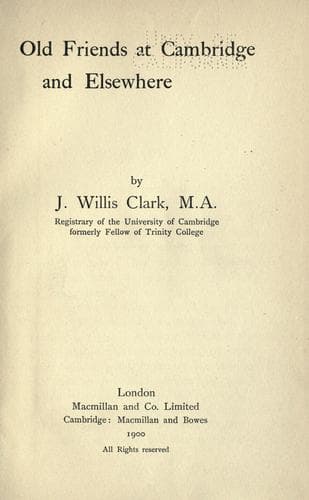
Old Friends at Cambridge and ElsewhereClark, John Willis
History
Old Friends at Cambridge and Elsewhere
Clark, John Willis
University of Cambridge -- History
‘It has the grave fault of immaturity; it was written, or rather
dictated, at great speed, and is consequently defaced by some oversights
which Palmer was incapable of committing if he had taken more time over
the work. But, in spite of all the objections that may be urged against
it, his translation has the true Desert ring in it; we may quarrel with
certain renderings, puzzle over occasional obscurities, regret certain
signs of haste or carelessness; but we shall be forced to admit that the
translator has carried us among the Bedawí tents, and breathed into us
the strong air of the Desert, till we fancy we can hear the rich voice
of the Blessed Prophet himself as he spoke to the pilgrims on
Akabah[103].’
Lastly, Mr Poole points out the peculiar excellence of Palmer’s Arabic
Grammar, which is arranged on the Arab system, in bold defiance of the
usual custom of treating Arabic in the same way that one treats Latin.
To these favourable criticisms of works beyond our powers of
appreciation we should like to add a word of praise of our own for the
historical introduction to the Koran, in which the career of Mahomet is
sketched in a few bold, vigorous lines, and the scope and object of the
work are analysed and explained. We regret that Palmer was not able to
devote more time to history; the above _Introduction_, and the _Life of
Haroun Alraschid_, seem to us to show that he would have excelled in
that style of composition. He could read the native authorities with
facility, and he knew how to put his materials to a good use. But alas!
all these peaceful studies were to be closed for ever by an enterprise
as masterly in its execution as it was terrible in its conclusion.
The suppression of Arabi’s revolt in Egypt created the greatest
enthusiasm in this country. The British Public dearly loves a war, and
every event in which our troops were concerned was eagerly read and
proudly commented on by enthusiastic sympathizers. But there were
probably not many who so much as read the scanty paragraphs which noted,
first, the anxiety respecting the fate of some Englishmen who had gone
into the Desert on a certain day in August 1882; and, subsequently, the
certainty of their murder. Palmer’s wonderful achievement has been told
for the first time by Mr Besant with a fulness of detail, a vividness of
descriptive power, and, we may add, a bitterness of grief, that only
those who read it carefully more than once can appreciate as such a
piece of work deserves to be appreciated. We shall try to set before our
readers the principal circumstances of those eventful days, treading in
his steps, and often using his very words.
Public-domain text, read in full here on John Shaqi.
Reviews
Reviews
No reviews yet
Be the first to share your thoughts on this work.
Elsewhere in the archive
Join the Discussion
Join the discussion
Sign in to leave a comment or review.
Sign InorCreate an account