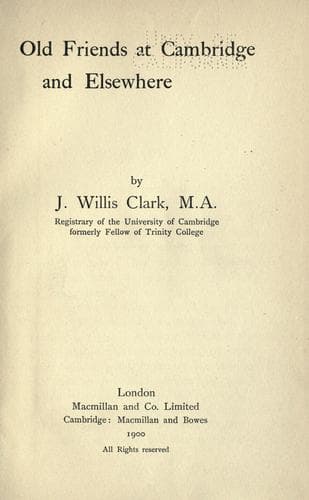
Old Friends at Cambridge and ElsewhereClark, John Willis
History
Old Friends at Cambridge and Elsewhere
Clark, John Willis
University of Cambridge -- History
We will now return to Meter ibn Sofieh. On arriving at his own camp he
collected his four sons and several other Bedouin, and came down to the
place of attack. This they were able to recognize by the dead or wounded
camel, which had not then been removed. Finding nobody there, they
shouted, and were answered by the prisoners in the hollow. Meter and
another went down to them and found them unguarded, their guard having
run away on the approach of strangers. Had Meter really come to save
them—and it is difficult to explain his return from any other motive
than that of a late repentance—there was not a moment to be lost. Much
valuable time, however, was wasted in useless expressions of pity and
exchange of Bedouin courtesies, and they had hardly reached Meter’s
camels before the hostile party came in sight. It is reported that
Meter’s men said, ‘Let us protect the Englishmen,’ and raised their
guns; but that Meter answered, ‘No, we must negotiate the matter,’ and
allowed his men to be surrounded by a superior force. What happened next
will never be known with certainty. Meter himself swore that he offered
£30 for each of the five; others, that he offered thirty camels for the
party; while there is a general testimony that Palmer offered all they
possessed if their lives could be spared, adding, ‘Meter has all the
money.’ The debate did not last long, not more than half an hour, and
then Meter retired, it being understood that the five[107] prisoners
were all to be put to death. The manner of the execution of this foul
design had next to be determined, and it seems to have been regarded as
a matter requiring much nicety of arrangement. The captors belonged to
two tribes, the Debour and the Terebin, and it was finally arranged that
two should be killed by the Debour, and three by the Terebin. The men
who were to strike the blow were next selected, one for each victim; and
when this had been done the prisoners were driven before their captors
for upwards of a mile, over rough ground, to the place of execution. It
was now near the middle of the day, and the unfortunate men had no means
of protecting their heads from the August sun. It is to be hoped,
therefore, that they were nearly unconscious before the spot was
reached. At that part of the Wady Sudr a ledge or plateau of rock, some
twenty feet wide, runs for a considerable distance along the steep face
of the cliffs; and below it the torrent cuts its way through a narrow
channel, not more than eighteen feet wide, with precipitous sides, about
fifty feet high. At the spot selected for the murder a mountain stream,
descending from the heights above, works its way down the cliffs to the
water below. The bed of this stream was then dry; but it would be a
cataract in the rainy season, and might be trusted to obliterate all
traces of the crime. The prisoners were forced down the mountain side
until the plateau was reached, and then placed in a row facing the
Public-domain text, read in full here on John Shaqi.
Reviews
Reviews
No reviews yet
Be the first to share your thoughts on this work.
Elsewhere in the archive
Join the Discussion
Join the discussion
Sign in to leave a comment or review.
Sign InorCreate an account