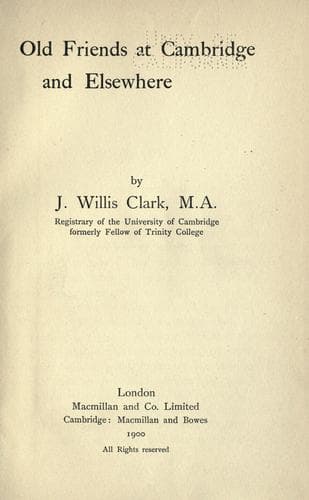
Old Friends at Cambridge and ElsewhereClark, John Willis
History
Old Friends at Cambridge and Elsewhere
Clark, John Willis
University of Cambridge -- History
torrent, the selected murderer standing behind each victim. Some of the
Bedouin swore that they were all shot at a given signal, and that their
bodies fell over the cliff; others that Abdullah was shot first, and
that the remaining four, seeing him fall, sprang forward, some down the
cliff, some along the edge of the gully. Three were killed, so they
said, before they reached the bottom; the fourth was despatched in the
torrent-bed by an Arab who followed him down. There is, however, reason
for believing that some at least were wounded or killed before they were
thrown into the abyss; for the rocks above were deeply stained with
blood. It may be that one or more of them had been wounded in the first
encounter, or intentionally maimed by their captors; and this may
explain what seems to us so strange, that they made no effort to escape
during the long hours they were left unguarded. At the moment of death
Palmer alone is said to have lifted up his voice, and to have uttered a
solemn malediction on his murderers. He knew the Arab character well,
and he may have thought that the last chance of escape was to terrify
his captors by the thought of what would come to pass if murderous hands
were laid upon him and his companions.
Justice was not slow to overtake the criminals. In less than two months
Colonel Warren, to whom the direction of the search-expedition was
entrusted[108], had discovered who they were, and had found some
scattered remains of their unfortunate victims in the gulf which they
hoped would conceal them for ever. In January 1883 he read the solemn
burial service of the Church at the spot in the presence of the brother
and sister of Lieutenant Charrington; after which, according to military
custom, the officers present fired three volleys across the torrent. On
the hill above they raised a huge cairn, 17 feet in diameter, and 13
feet in height, surmounted by a cross, which the Bedouin were charged,
at their peril, to preserve intact. Of the actual murderers three were
executed, as also were two headmen for having incited them to the crime.
Others were imprisoned for various terms of years, and the Governor of
Nakhl, who was proved to have been privy to the murder, and near the
place at the time, was imprisoned for a year and dismissed the service.
The end of Meter ibn Sofieh was strangely retributive. He had led the
party out of their way into an ambuscade[109], probably for the paltry
gain of £3000, for we have seem that his nephew escaped with the gold,
and £1000 was afterwards found in the place where he knew it was hid; he
had betrayed the man with whom he had solemnly eaten bread and salt in
Misleh’s camp only a month before; he hid himself in the Desert for
awhile, then he gave himself up, and told as much of the story as he
probably dared to tell; then he fell ill—his manner had been strange
ever since the murder, it was said—he was taken to the hospital at Suez,
and there he died.
Public-domain text, read in full here on John Shaqi.
Reviews
Reviews
No reviews yet
Be the first to share your thoughts on this work.
Elsewhere in the archive
Join the Discussion
Join the discussion
Sign in to leave a comment or review.
Sign InorCreate an account