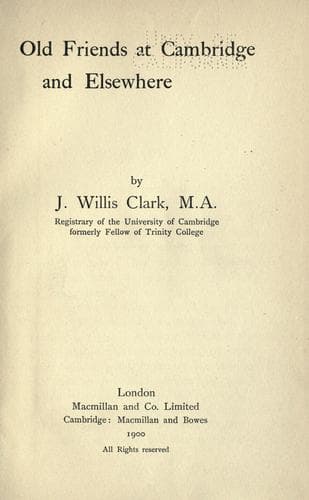
Old Friends at Cambridge and ElsewhereClark, John Willis
History
Old Friends at Cambridge and Elsewhere
Clark, John Willis
University of Cambridge -- History
Mr Balfour was a younger son of the late Mr J. M. Balfour of
Whittinghame, near Prestonkirk, and of the late Lady Blanche Balfour, a
sister of Lord Salisbury. He entered at Trinity College, Cambridge, from
Harrow, in October 1870. He brought from school the reputation of being
a clever boy, whom the masters liked and respected, but of not
sufficient ability to distinguish himself remarkably at Cambridge. Those
who expressed this opinion overlooked the fact that he had already
evinced a decided bent for Natural Science, and had published a brief
memoir on the geology of his native county, Haddingtonshire. In his very
first term he was fortunately induced to attend the biological lectures
of the Trinity Prælector in Physiology, Mr Michael Foster; he made rapid
progress, and at Easter 1871 he obtained the Natural Science Scholarship
at Trinity College. He at once commenced original research in the
direction in which he was afterwards to be so distinguished; and after
two years’ work published a paper on _The Development of the Chick_ in
the _Microscopical Journal_ for July, 1873. Indeed, we believe that the
time spent on this and kindred investigations diminished somewhat the
brilliancy of his degree, for he was placed second instead of first, as
had been expected, in the Natural Sciences Tripos of 1873.
In November of that year he was nominated by the Board of Natural
Science Studies to work at the Zoological Station at Naples, then lately
established by Dr Anton Dohrn. His object in going there was to continue
his investigations on Development, and before starting he had determined
to study the Elasmobranch Fishes (Sharks and Rays), as it seemed likely,
from their pristine characters, that their development would throw great
light on the early history of vertebrate animals. The result showed how
wisely he had made his selection. He made discoveries of the highest
value in reference to the development of certain organs, and the origin
of the nerves from the spinal cord—points which had baffled the most
acute previous observers. These were not merely valuable for the history
of the special group from which they were derived, but threw a flood of
light upon the connexion between vertebrates and invertebrates, and
their derivation from a common ancestry; views which he expanded
afterwards in his work on Embryology. The results of his Neapolitan
researches were embodied in the dissertation upon which he rested his
candidature for a Fellowship at Trinity College; and were afterwards
printed in the _Philosophical Transactions_ for 1875. Fortunately for
him, a Natural Science Fellowship was vacant in 1874, to which he was
elected, in consequence of the value of this dissertation. It is what is
called an open secret that its great merits were at once recognized by
Professor Huxley, to whom it had been referred.
Public-domain text, read in full here on John Shaqi.
Reviews
Reviews
No reviews yet
Be the first to share your thoughts on this work.
Elsewhere in the archive
Join the Discussion
Join the discussion
Sign in to leave a comment or review.
Sign InorCreate an account