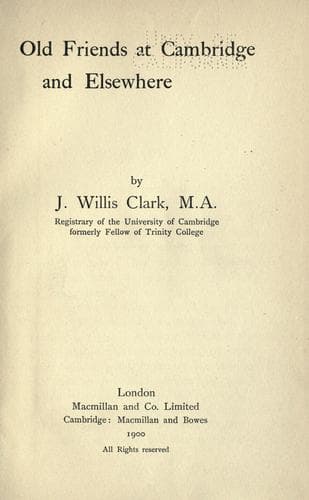
Old Friends at Cambridge and ElsewhereClark, John Willis
History
Old Friends at Cambridge and Elsewhere
Clark, John Willis
University of Cambridge -- History
From that time forward Balfour devoted himself unremittingly to
continuous research in preparation for his systematic treatise on
Embryology, the plan of which he had already sketched out, and which was
finally completed and published in 1881. Before this appeared, however,
he had published numerous papers of great value, covering nearly the
whole range of his subject. Many of these will be found in the
_Quarterly Journal of Microscopical Science_, of which he was one of the
editors. As an original investigator he had no equal. He was skilful in
manipulation, and observed rapidly and exactly, so that no point escaped
his notice. His mind was calm and wholly free from prejudice, with a
singularly broad and original grasp, which enabled him to seize, with
readiness and sureness, the principle which lay under a number of
apparently discordant facts. At the same time, like every true genius,
he was singularly modest and retiring, always ready to depreciate the
value of his own work, and to put forward that of others, especially of
men younger than himself. We know of many students, now rising to
distinction, who owe their first success to his generous encouragement,
and, we may add, in some cases to his bountiful assistance, given with a
delicacy which doubled the value of the gift. It was this strong desire
to encourage others to work at Natural Science that induced him, in
1875, to undertake a class in Animal Morphology, or, as it used to be
called, Comparative Anatomy. At first only a few students presented
themselves, and one small room at the New Museums was sufficient for
their accommodation. The class, however, grew with surprising rapidity;
and, after Mr Balfour’s appointment as Natural Science Lecturer to
Trinity College, it became necessary to build new rooms for his use.
During the year 1881 the numbers had reached an average of nearly sixty
in each term; and just before he left England for the excursion which
has ended so fatally he had superintended the plans for a yet further
extension of the Museum Buildings.
His reputation as a successful teacher soon became known far and wide;
students came from a distance to work under his direction; and he
received tempting offers to go elsewhere. It need no longer be a secret
that, after the death of Professor Wyville Thompson, the Chair of
Natural History at Edinburgh was offered to him; or that, after the
death of Professor Rolleston, he was strongly urged by the leading men
in Natural Science at Oxford to accept the Linacre Professorship of
Anatomy and Physiology. But he was devoted to Cambridge, and nothing
would induce him to leave it. His refusal of posts so honourable induced
the University, somewhat tardily perhaps, to recognize his merits, and a
new Professorship was established in the course of last term for that
especial purpose. We extract a few sentences from the Report in which
the Council of the Senate recommended this step[112]:
Public-domain text, read in full here on John Shaqi.
Reviews
Reviews
No reviews yet
Be the first to share your thoughts on this work.
Elsewhere in the archive
Join the Discussion
Join the discussion
Sign in to leave a comment or review.
Sign InorCreate an account