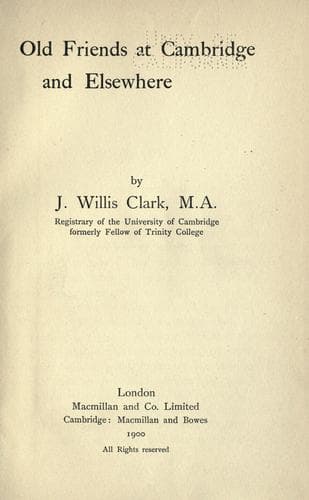
Old Friends at Cambridge and ElsewhereClark, John Willis
History
Old Friends at Cambridge and Elsewhere
Clark, John Willis
University of Cambridge -- History
But it is not merely as a man of science that Mr Balfour will be
remembered. He was not one of those enthusiasts who can see nothing
beyond the limits of their own particular studies. He was a man of wide
sympathies and interests. He devoted much time and attention to College
and University affairs; and was an active member of numerous Syndicates,
to whose special business he applied himself with infinite energy. He
was also a keen politician on the Liberal side, and an ardent University
reformer. His complete mastery of facts, his retentive memory, and his
admirable powers of reasoning, made him a formidable antagonist in
argument; but, though he rarely let an opportunity for vindicating his
own opinions go by without taking full advantage of it, we never heard
that he either lost a friend or made an enemy. He was so thoroughly a
man “who bore without abuse the grand old name of gentleman,” that he
could never be a mere disputant. He approached every subject with the
earnestness of sincere conviction, and he invariably gave his opponents
credit for a sincerity equal to his own. It was only when he found
himself opposed to presumption, shallowness, or ignorance, that the
natural playfulness of his manner ceased, his mild and delicate features
darkened to an unwonted sternness, and his habitually gentle voice grew
cold and severe. We have heard it said that he was too uniformly
earnest, that he took life too seriously, and that he lacked the saving
grace of humour. But his earnestness was perfectly genuine, and he would
have joined hands with the Philistines in scorning the follies of the
“intense.” With the undergraduates he was immensely popular. Besides his
great success as a teacher, he had the inestimable gift of sympathy;
they felt that they had in him a friend who thoroughly understood them,
and they trusted him implicitly; while the members of his own special
class regarded him with a veneration which it has been the lot of few
teachers to inspire. Nor was his influence upon men older than himself
less remarkable. They were fascinated by his exquisite courtesy; his
quiet, high-bred dignity; his respect for the opinions and feelings of
others. No one of late years has exerted so strong a personal influence
in the University. It was the vigour of this personality which enabled
Natural Science to take the place it now occupies in Cambridge life. He
began to teach at a time when the rising popularity of science was
regarded with dislike and suspicion by not a few persons. He left it
accepted as one of the studies of the place. What will happen now that
he has been taken away it is hard to foresee. We hope and believe that
Natural Science is too deeply rooted at Cambridge to be permanently
affected by even his loss. We trust that the strong efforts which will
be made to keep together the school which he had created may be
successful; but we fear that it will soon be evident that the members of
Public-domain text, read in full here on John Shaqi.
Reviews
Reviews
No reviews yet
Be the first to share your thoughts on this work.
Elsewhere in the archive
Join the Discussion
Join the discussion
Sign in to leave a comment or review.
Sign InorCreate an account