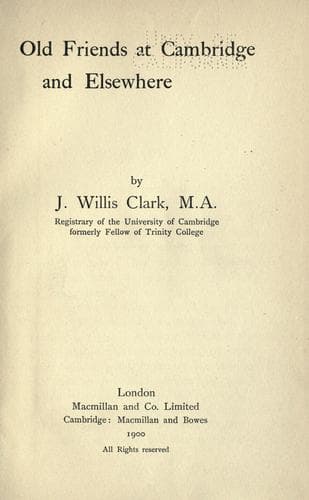
Old Friends at Cambridge and ElsewhereClark, John Willis
History
Old Friends at Cambridge and Elsewhere
Clark, John Willis
University of Cambridge -- History
the University have lost not merely a very dear friend, but also a
master.
_29 July, 1882._
HENRY BRADSHAW.
The past twelve months have been singularly fatal to Cambridge; but no
loss has caused grief so widespread and so sincere as that of the
distinguished scholar and man of letters who passed quietly away while
sitting at his library-table on the night of last Wednesday week[113].
If proof were needed of the respect in which he was held, we have only
to point to the vast assemblage of past and present members of the
University which filled the chapel of King’s College on Monday last to
do honour to his funeral. Nor will the grief be confined to Cambridge.
Though Mr Bradshaw rarely quitted his own University, and took no
trouble to bring himself into notice, few men were more highly
appreciated, both at home and abroad. It is hardly necessary to observe
that this recognition of his merits was of no sudden growth. We can
recall the time when he was working silently and unknown, and when even
a small circle of devoted friends had not realised the extent and
thoroughness of those studies which he carefully kept in the background.
But gradually the world of letters became aware that there were many
points in bibliography and kindred subjects which could not be set on a
right footing unless the inquirer were willing to pay a visit to him. No
one who did so had any cause to regret his journey. He was certain to be
received with a courtesy which, we regret to say, is nowadays commonly
called old-fashioned, and to find himself before he left far richer than
when he came. Mr Bradshaw was the most unselfish of men; and the stores
of his knowledge were invariably laid open, freely and ungrudgingly, to
every inquirer, provided he was satisfied that the work proposed would
be thoroughly well done. He was modest to a fault; and we believe that
he really preferred to remain in the background, while others, at his
suggestion and with his help, worked out the subjects in which he took
special interest. It was no fault of theirs if his share in their work
remained a secret. His generous wish to help others forward made him
refuse more than once, as we well know, to allow his name to appear in
connexion with work that he had really done; and posterity will have to
tax its ingenuity to discover, from a few words in a preface or a line
in a note, how much belongs of right to him. Nor was it only in subjects
with which he was specially familiar that his help was valuable. He
seemed equally at home in all branches of knowledge. He knew so
thoroughly how materials should be used, and in what form the results
would be best presented, that, whether the subject were art, or
archeology, or history, or bibliography, or early English texts, his
clear and accurate judgment went straight to the point, and reduced the
most tangled facts to order. But, devoted student as he was, he was no
bookworm.
Public-domain text, read in full here on John Shaqi.
Reviews
Reviews
No reviews yet
Be the first to share your thoughts on this work.
Elsewhere in the archive
Join the Discussion
Join the discussion
Sign in to leave a comment or review.
Sign InorCreate an account