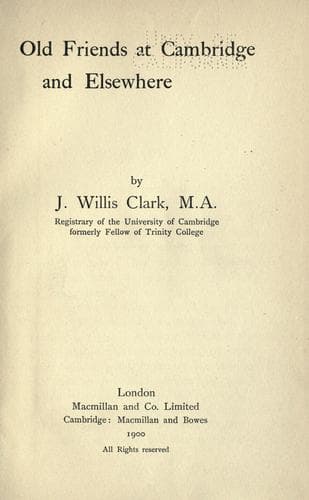
Old Friends at Cambridge and ElsewhereClark, John Willis
History
Old Friends at Cambridge and Elsewhere
Clark, John Willis
University of Cambridge -- History
He took the liveliest interest in all that was going on around
him. His strong common sense, his kind, charitable nature, and his habit
of going to the bottom of every question presented to him, enabled him
to sympathize with those who had arrived at conclusions widely different
from his own. As a younger man he was too reserved, too diffident of
himself, to feel at ease in the society of men of his own standing. He
thought they disliked him, and this idea increased his natural
sensitiveness and his love of retirement. The truth was that he was too
honest to be popular. Like Alceste in _Le Misanthrope_, he would rebuke
insincerity and pretentiousness with a few blunt stern words that made
the offender tremble; and, if he disliked anybody, as happened
sometimes, he took no pains to conceal it. Hence he was respected, but
he was not liked. By slow degrees, however, the natural geniality of his
disposition gained the upper hand, and the warm heart which beat under
that calm exterior was allowed to assert itself. The old severity of
denunciation, instead of being exercised on individuals, was reserved
for slovenly work, unjust criticism, or unfair treatment. He began to go
more into society, in which he took a keen pleasure, though he would
rarely allow himself to spend what he called an idle evening. At all
times he had sought the company of young people. At a period when
undergraduates hardly ventured to speak to men older than themselves,
his quiet kindness attracted them to him, and obtained their confidence.
In him they were certain of a friend whose sympathy never failed them,
and from whom, no matter what trouble or difficulty had befallen them,
they were sure of advice and help. Many a man now successful in life may
thank him for the influence which, exercised at a critical time,
determines a career for good; and not a few have been enabled by his
generosity to begin the studies in which they are now distinguished.
Public-domain text, read in full here on John Shaqi.
Reviews
Reviews
No reviews yet
Be the first to share your thoughts on this work.
Elsewhere in the archive
Join the Discussion
Join the discussion
Sign in to leave a comment or review.
Sign InorCreate an account