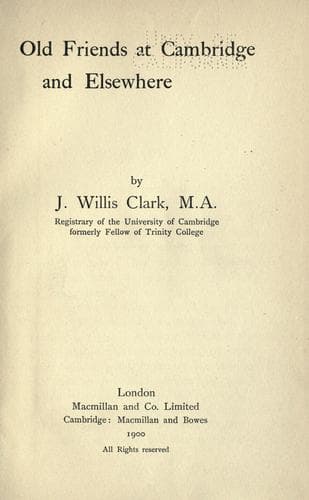
Old Friends at Cambridge and ElsewhereClark, John Willis
History
Old Friends at Cambridge and Elsewhere
Clark, John Willis
University of Cambridge -- History
In their society he laid the foundation of that wide knowledge of
literature, that keen interest in whatever was going forward, that habit
of weighing all things in the nicely-adjusted balance of thoughtful
criticism, which made what he wrote so valuable, and what he said so
delightful. Nor, after he had obtained his Fellowship, and was free to
do as he liked, was he content to become a student and nothing more. He
was careful to add a knowledge of men and manners to what he was
learning from books. He travelled abroad, and acquired a competent
knowledge of more than one modern language; he was fond of art, and a
good judge of pictures and sculpture. Nor did he forget the friends of
his undergraduate days. He was a welcome, and we believe a frequent,
guest at their houses both in town and country, where his fine presence,
his courteous bearing, and his quiet, epigrammatic conversation were
keenly appreciated. To the influence of these social surroundings he
owed that absence of narrowness which is inseparable from a University
career, if it be not tempered by influences from the outside.
Academic lives usually contain few details to arrest the biographer, and
his was no exception to the rule. His father was a solicitor at York,
and he was born in that city 27 March, 1810. He was educated at a
private school, which he left when thirteen years old, and was then
placed under the care of a tutor, with whom he remained until he came up
to Trinity in the Michaelmas Term, 1828, as one of the pupils of Mr
Peacock, afterwards Dean of Ely. To his watchful care and sound advice
Thomson felt himself under deep obligation, and in after-life he used to
describe him as “the best and wisest of tutors.” It had been at first
intended that he should enter as a sizar; but this decision was reversed
at the last moment, and he matriculated as a pensioner. He obtained a
scholarship in 1830, and one of the Members’ prizes for a Latin Essay in
1831. At that time candidates for Classical Honours could not present
themselves for the Classical Tripos until they had satisfied the
examiners for the Mathematical. Thompson must have devoted a
considerable portion of his time to that subject, for he appears in the
Tripos of 1832 as tenth Senior Optime. In the Classical Tripos of the
same year he obtained the fourth place, being beaten by Lushington,
Shilleto, and Dobson, the first of whom beat him again in the
examination for the Chancellor’s medals, of which he won only the
second. He was elected Fellow of his College in 1834. His reputation as
a scholar marked him out for immediate employment as one of the
assistant-tutors; but for a time either no vacancy presented itself, or
men senior to himself were appointed. Meanwhile he accepted a mastership
in a school at Leicester, work which, we believe, he did not find
congenial. In October 1837 he was recalled to Cambridge by the offer of
an assistant-tutorship. In 1844, on the retirement of Mr Heath, he
Public-domain text, read in full here on John Shaqi.
Reviews
Reviews
No reviews yet
Be the first to share your thoughts on this work.
Elsewhere in the archive
Join the Discussion
Join the discussion
Sign in to leave a comment or review.
Sign InorCreate an account