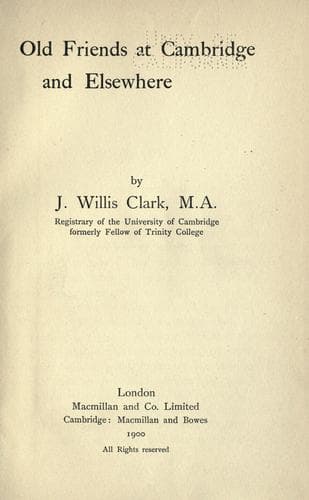
Old Friends at Cambridge and ElsewhereClark, John Willis
History
Old Friends at Cambridge and Elsewhere
Clark, John Willis
University of Cambridge -- History
became tutor, an office which he held until he obtained the Regius
Professorship of Greek in 1853. The other candidates on that occasion
were Shilleto and Philip Freeman, but the electors were all but
unanimous in their choice of Thompson. In the spring of 1866, on the
death of Dr Whewell, he was appointed to the Mastership of Trinity
College.
In attempting to estimate the value of his work as a classical teacher,
it must be remembered that he was the direct heir of the system
introduced into Trinity College by Hare and Thirlwall. We are not aware
that he attended the lectures of the former, though he may well have
done so, but we have heard from his own lips that he derived great
benefit from those of the latter, which were as systematic as Hare’s had
been desultory. Those distinguished scholars, while not neglecting an
author’s language, were careful to direct the attention of their pupils
to his matter. They did not waste time unduly on the theories of this or
that commentator, though they had carefully digested them, but they
showed how their author might be made to explain himself. In fine, the
discovery of his thoughts, not the dry elucidation of his words, was the
object of their teaching. Translation, again, received from them a
larger share of attention than it had done from their predecessors. In
this particular Thompson attained an unrivalled excellence. His
translations never smelt of the lamp, though it may be easily imagined
that this perfection had not been arrived at without much preliminary
study. But, when presented to the class, toil was carefully kept out of
sight. The lecturer stood at his desk and read his author into English,
with neither manuscript nor even notes before him, as though the
translation was wholly unpremeditated, in a style which reflected the
original with exact fidelity, whatever the subject selected might be. He
seemed equally at home in a dialogue of Plato, a tragedy of Euripides in
which, like the _Bacchae_, the lyric element predominates, or a comedy
of Aristophanes. He did not labour in vain. The lecture-room was crowded
with eager listeners; and the happiest renderings were passed from mouth
to mouth, and so made the round of the University. But we are glad to
think that his fame as a scholar rests on a firmer foundation than
traditions of the lecture-room, however brilliant. The author of his
choice was Plato, and though ill-health and a too fastidious criticism
of his own powers, which made him unwilling to let a piece of work go
out of his hands so long as there was any chance of making it better,
stood in the way of the complete edition, or, at any rate, translation,
of the author, which he once meditated, yet he has left enough good work
behind him to command the gratitude of future scholars. To this study he
was doubtless directed, in the first instance, by natural predilection;
but, if we mistake not, he was confirmed in it by the scholars
Public-domain text, read in full here on John Shaqi.
Reviews
Reviews
No reviews yet
Be the first to share your thoughts on this work.
Elsewhere in the archive
Join the Discussion
Join the discussion
Sign in to leave a comment or review.
Sign InorCreate an account