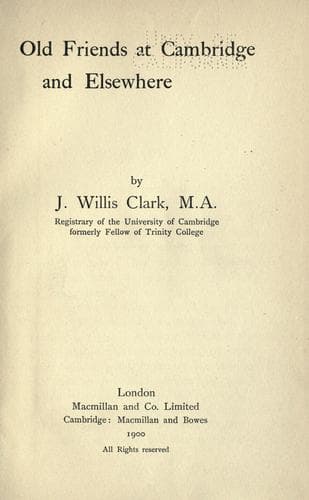
Old Friends at Cambridge and ElsewhereClark, John Willis
History
Old Friends at Cambridge and Elsewhere
Clark, John Willis
University of Cambridge -- History
The Society of Trinity College had long been aware of the critical
condition of their Vice-Master’s health, and his numerous friends in the
wider circle of the University had shared their alarm. And yet, though
everybody had been expecting the worst for several weeks, the news that
the end had really come[116] fell upon the University with the stunning
force of a wholly unexpected event. The full extent of the loss can only
be measured by time; for the moment we can but feel that the University
of Cambridge misses an influence which pervaded and animated every
department of her affairs. For the last fifteen years no one has been so
completely identified with what may be termed modern Cambridge; no one
has been admitted to so large a share in her councils, or has devoted
himself with such unremitting diligence to the administration of her
complex organization.
Mr Trotter proceeded to his degree in 1859. He was thirty-seventh
wrangler, and third in the second class of the Classical Tripos. It is
evident, however, that his acquirements must not be measured by his
place in these two Triposes, for he was soon after elected to a
Fellowship in his college, where, as is well known, the proficiency of
candidates is tested by a fresh examination. After his election he took
Holy Orders, and devoted himself for a time to active clerical work. For
this, however, after a fair trial, he found himself unsuited, and,
resigning his curacy, he returned to college. Between the years 1865 and
1869 he spent a considerable portion of his time in German universities.
In 1869 he became Lecturer in Natural Science in Trinity College, and in
due course succeeded to the Tutorship. In 1874 he was elected a member
of the Council of the Senate—a position which he occupied, without
interruption, until his death. In early life he had been a staunch
Conservative; but, as time went on, his views changed, and he became not
only a Liberal in politics, but an ardent University reformer. In the
latter capacity he threw himself energetically into the movement for
reform which led to the present University and College statutes—to
which, in their actual shape, he largely contributed. We have said that
he was a Liberal and a reformer. This position placed him, it is almost
needless to remark, in direct antagonism to many of those with whom he
was called upon to act; but his conciliatory manners, his excellent
temper, and his perfect straightforwardness, not only disarmed
opposition, but enabled him to make friends even among those who
differed from him most widely. In fact, what was sometimes called in
jest ‘the Trotterization of the University’ was so complete that he had
come to be regarded as indispensable; and his name will be found at one
time or another on all the more important Boards and Syndicates. But it
was not merely his knowledge of University business and detail that
placed him there. He was gifted with an intelligence of extraordinary
quickness.
Public-domain text, read in full here on John Shaqi.
Reviews
Reviews
No reviews yet
Be the first to share your thoughts on this work.
Elsewhere in the archive
Join the Discussion
Join the discussion
Sign in to leave a comment or review.
Sign InorCreate an account