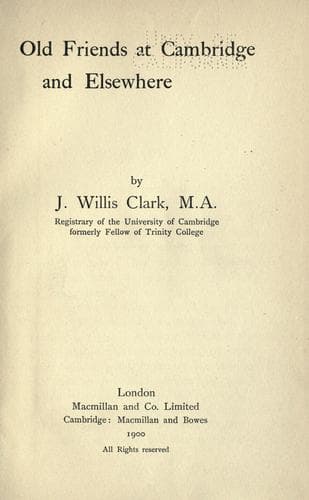
Old Friends at Cambridge and ElsewhereClark, John Willis
History
Old Friends at Cambridge and Elsewhere
Clark, John Willis
University of Cambridge -- History
‘side’ got into trouble; but it may be questioned whether many a
delinquent would not have preferred public exposure to the awful
half-hour in his tutor’s study by which his rescue was succeeded. Nor
did his interest in his pupils cease when they left college. He was
always glad to see them or to write to them, and few, we imagine, took
any important step in life without consulting him.
When Thompson became Greek Professor, a canonry at Ely was still united
to the office—an expedient for augmenting the salary which, we are glad
to say, will not trouble future Professors. To most men, trained as he
had been, the new duties thus imposed upon him would have been
thoroughly distasteful; and we are not sure that he ever took a real
pleasure in his residences at Ely. In fact, more than one bitter remark
might be quoted to prove that he did not. Notwithstanding, he made
himself extremely popular there, both with the Chapter and the citizens,
and he soon became a good preacher. It is to be regretted that only one
of his sermons—that on the death of Dean Peacock—has been printed; that
one is in its way a masterpiece.
He became Master rather late in life, when the habits of a bachelor
student had grown upon him; and he lacked the superabundant energy of
his great predecessor. But notwithstanding, the twenty years of his
Mastership were years of activity and progress; and he took his due
share of University and College business. He was alive to the necessity
for reform, and the statutes framed in 1872, as well as those which
received the royal assent in 1882, owed much to his criticism and
support. It should also be recorded that he was an excellent examiner,
appreciating good work of very different sorts. Gradually, however, as
his health grew worse, he was compelled to give up much that he had been
able to do when first elected, and to withdraw from society almost
entirely. Yet he did not become a mere lay figure. Even strangers who
caught a glimpse in chapel of that commanding presence, the dignity of
which was enhanced by singularly handsome features, and silvery
hair[115], were compelled to recognize his power. There was an innate
royalty in his nature which made his Mastership at all times a reality,
and he contrived, from the seclusion of his study, to exert a stronger
influence and to maintain a truer sympathy with the Society than
Whewell, with all his activity, had ever succeeded in
establishing. His very isolation from the worry and bustle of the world
gave authority to his advice; those who came to seek it felt, as they
sat by his armchair, that they were listening to one who was not
influenced by considerations of the moment, but who was giving them some
of the garnered treasures of mature experience.
_9 October, 1886._
COUTTS TROTTER.
Public-domain text, read in full here on John Shaqi.
Reviews
Reviews
No reviews yet
Be the first to share your thoughts on this work.
Elsewhere in the archive
Join the Discussion
Join the discussion
Sign in to leave a comment or review.
Sign InorCreate an account