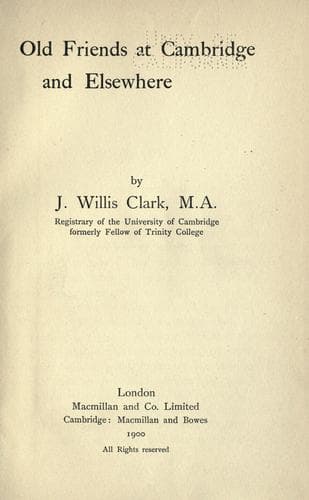
Old Friends at Cambridge and ElsewhereClark, John Willis
History
Old Friends at Cambridge and Elsewhere
Clark, John Willis
University of Cambridge -- History
The death of Dr Okes, though he had reached the mature age of
ninety-one, has taken the University by surprise[117]. He had become an
institution of the place. While everything around him changed, and old
things became new, his venerable figure remained unaltered, like a
monument of an older faith which has survived the attacks of successive
iconoclasts, to tell the younger generation what manner of men the Dons
of the past had been. He was fond of saying that the first public event
he could distinctly remember was the battle of Trafalgar. He had been a
Master at Eton when Goodall was Provost and Keate Head-master, and he
had begun to rule over King’s College when the University of Cambridge
differed as widely from what it is now as the Europe of Napoleon from
its present condition. Still, his load of years sat so lightly upon him,
his interest in what was going forward was still so keen, that there
seemed to be no reason why he should not complete his century of life.
The slight infirmities from which he suffered did not prevent him, until
quite lately, from attending service in chapel, at least on Sundays; his
hearing was but little affected; his sight was good; and he could still
enjoy the society of his friends. Only a few days before his death he
was reading Miss Burney’s _Evelina_ to his daughters. When it became
known on Sunday last that he had really passed away, it was hard to
believe that the sad news could possibly be true.
Richard Okes was born in Cambridge, 15 December, 1797. His father,
Thomas Verney Okes, was a surgeon in extensive practice. Tradition is
silent respecting the future Provost’s childhood and early education;
but, as in those days boys began their lives at Eton at a very early
age, it is probable that when he was little older than a child he was
sent to fight his battles among the collegers, in what even devoted
Etonians have called ‘a proverb and a reproach’—Long Chamber. In 1816,
when he was rather more than eighteen, he obtained a scholarship at
King’s College; but it appears from the University records that he did
not formally matriculate until November in the following year. In those
days, be it remembered, King’s College was a very different place from
what it is now, both structurally and educationally. The magnificent
site, on which Henry VI. intended to place an equally magnificent
college, was occupied by no structures of importance except the Chapel,
and the Fellows’ Building, part of a second grand design which, like the
first, was never completed. The scholars, or at all events the greater
part of them, were packed into Old Court—the small, irregular quadrangle
west of the University Library, to which the founder intended originally
to limit his college. It must have been a curious structure—picturesque
and interesting from an archeological point of view, but unwholesome and
uncomfortable as a place of residence. The very nicknames given to some
Public-domain text, read in full here on John Shaqi.
Reviews
Reviews
No reviews yet
Be the first to share your thoughts on this work.
Elsewhere in the archive
Join the Discussion
Join the discussion
Sign in to leave a comment or review.
Sign InorCreate an account