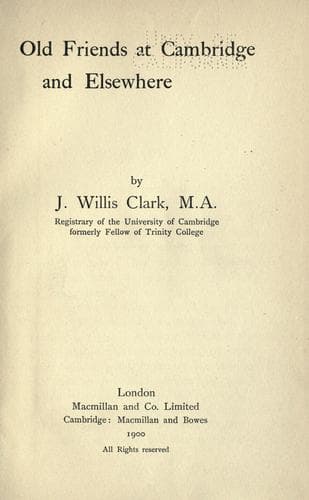
Old Friends at Cambridge and ElsewhereClark, John Willis
History
Old Friends at Cambridge and Elsewhere
Clark, John Willis
University of Cambridge -- History
of the chambers—“the Tolbooth,” “the Block-house,” and the like—are a
sufficient proof of their discomfort. In one of these, on the ground
floor, facing Clare Hall, young Okes resided; and until a few months
ago, when the last remnant of this part of the old college was absorbed
by the University Library, the present generation could form a fairly
correct idea of the gloom and damp that their ancestors were obliged to
put up with. But members of Kings College had to endure something far
worse than physical discomfort. It had been the object of their founder
to make his college independent of the University, and, as a consequence
of these well-intentioned provisions, scholars of King’s were not
allowed to compete for University honours, but obtained their degrees as
a matter of course. The result is not difficult to conceive. In every
society there will be some whose love of letters, or whose ardour for
distinction, is so strong that nothing can check it; but, as a rule, the
young Etonians who were obliged to spend three years in Cambridge threw
learning to the winds, and enjoyed to their hearts’ content the liberty,
not to say license, of their new surroundings. It was a bad state of
things; and that Okes felt it to be so is proved by the eagerness with
which he, a strong Conservative, set himself to get it abolished as soon
as he had the power to do so. We do not claim for the late Provost any
specially studious habits as a young man; he was too genial and too fond
of society to have ever been a very hard reader; but his scholarship in
after years would not have been as accurate as it certainly was had he
wasted his time at Cambridge; and, as a proof that he aimed at
distinction, it should be mentioned that he obtained Sir William
Browne’s prize for Greek and Latin Epigrams in 1819 and 1820. To the
very end of his life he was fond of writing Latin verse; and when the
Fellows of his college congratulated him on his ninetieth birthday in
Latin and English poems, he replied in half-a-dozen Latin lines which
many a younger scholar could not have turned so neatly.
Public-domain text, read in full here on John Shaqi.
Reviews
Reviews
No reviews yet
Be the first to share your thoughts on this work.
Elsewhere in the archive
Join the Discussion
Join the discussion
Sign in to leave a comment or review.
Sign InorCreate an account