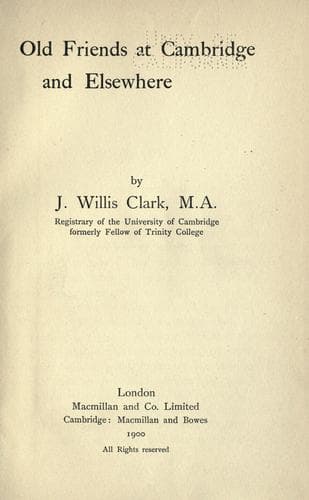
Old Friends at Cambridge and ElsewhereClark, John Willis
History
Old Friends at Cambridge and Elsewhere
Clark, John Willis
University of Cambridge -- History
When he returned to the University the ancient constitution still
subsisted, and it may be doubted whether he could ever have brought
himself into cordial sympathy with the changes inaugurated by the
statutes which came into operation in 1858. The abolition of the old
_Caput_, and the virtual dethronement of the Heads of Colleges, must
have seemed to him to be changes which savoured of sacrilege. Still,
when a reform had been once carried he accepted it loyally, and never
tried by underhand devices to thwart its provisions, or to diminish its
force. He was too straight-forward to pretend that he liked change, but
he was too honest to take away with one hand the assent that he gave
with the other. In regard to his own college he was before all things an
Etonian, and he clung to the ancient system by which King’s was
recruited exclusively from Eton. But, when it was decided, in 1864, to
throw the college open, under certain restrictions, to all comers, he
offered no violent resistance to the scheme, though he did not like it;
and it may be doubted whether he ever felt that the newcomers were
really King’s-men. His sense of duty, as well as his natural kindliness,
compelled him to accept them; but he looked upon them as aliens. This
strong conservative bias, opposed to the liberal instincts of a society
which his own reform had created, sometimes brought him into collision
with his Fellows; but such differences were not of long duration. He was
never morose. He never bore a grudge against any one. His sense of
humour, and his natural gaiety of spirits, carried him through
difficulties which his habitual tone of mind would hardly have enabled
him to surmount. When his portrait was painted by Herkomer, the artist
showed him as he lived, with a smile on his kind face. It was objected
that so jocose a countenance was at variance with the dignity of his
position. ‘What would the Provost of King’s be without his jokes?’ was
the reply of a sarcastic contemporary. The remark had a deeper meaning
than its author either imagined or intended.
_1 December, 1888._
HENRY RICHARDS LUARD[118].
Nearly half a century has elapsed since Dr Luard became a member of
Trinity College. When he came up, the University was a very different
place from what it is now; the Statutes of Elizabeth were still in
force; and the only study which obtained official recognition was that
of mathematics. It is true that a Classical Tripos existed, but anybody
who wished to be examined in it was obliged to obtain an honour in
Mathematics first. The first Commission was not appointed until 1850,
the year in which he proceeded to the degree of Master of Arts. Nor were
the changes that resulted from their labours so sweeping as to alter, to
any overt and material extent, the character of the University. The
University of our own time, due to more recent legislation, did not come
into being until he had reached middle life.
Public-domain text, read in full here on John Shaqi.
Reviews
Reviews
No reviews yet
Be the first to share your thoughts on this work.
Elsewhere in the archive
Join the Discussion
Join the discussion
Sign in to leave a comment or review.
Sign InorCreate an account