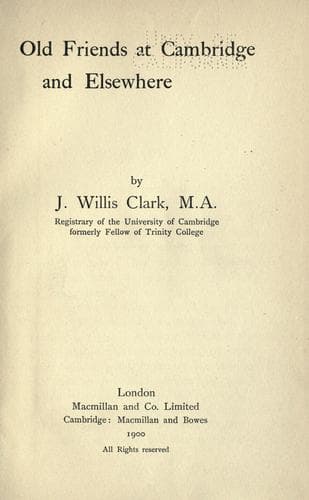
Old Friends at Cambridge and ElsewhereClark, John Willis
History
Old Friends at Cambridge and Elsewhere
Clark, John Willis
University of Cambridge -- History
He proceeded to his degree in 1821, and was in due course elected Fellow
of his college. Soon afterwards he returned to Eton as an
Assistant-Master. Mr Gladstone was one of the first set of boys who, in
Eton phrase, were ‘up to him’ in school. He filled his difficult
position with a judicious blending of severity and kindliness that made
him thoroughly respected by everybody, and at the same time beloved by
those boys who saw enough of him to discover that his dignified and
slightly pompous demeanour concealed a singularly warm and sympathetic
heart. His house was well-conducted and deservedly popular; and though
in those days masters did not see much of their pupils in private, he
contrived to turn several of his boys into life-long friends. In 1838 he
became Lower Master—an office which he held until he returned to
Cambridge in 1850. While in that influential position he introduced at
least one reform into the school; he got what was called ‘an
intermediate examination’ established, by which the collegers were
enabled to test their capacities before submitting to the final
examination which was to determine their chances of obtaining a
scholarship at King’s.
In November 1850, the Provostship of King’s College having been vacated
by the death of the Rev. George Thackeray, Dr Okes was elected his
successor. So anxious was he to abolish the anomalous position of
King’s-men with regard to University degrees that, on his way from Eton
to Cambridge to be inducted into his new dignity, he stayed a few hours
in London to take counsel with the Bishop of Lincoln, as Visitor of the
college, on the best way of effecting an alteration. The needful
negotiations were pressed forward without loss of time, and on the 1st
May, 1851, the college informed the University of their willingness to
abolish the existing state of things. The University, as might have been
expected, took time to consider the matter; and it was not until
February 18, 1852, that the Senate accepted the proposed reform.
Meanwhile Dr Okes had been elected Vice-Chancellor, and, in virtue of
that office, had the pleasure of signing the report which concluded the
negotiations. His year of office as Vice-Chancellor ended, he took but
little part in University business. He served on the Council of the
Senate from 1864 to 1868, and he was occasionally a member of
Syndicates; but, with these exceptions, he devoted himself to the
affairs of his college.
Public-domain text, read in full here on John Shaqi.
Reviews
Reviews
No reviews yet
Be the first to share your thoughts on this work.
Elsewhere in the archive
Join the Discussion
Join the discussion
Sign in to leave a comment or review.
Sign InorCreate an account