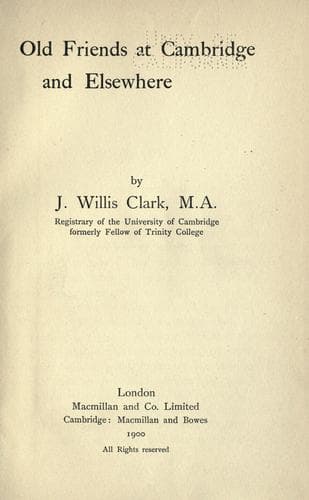
Old Friends at Cambridge and ElsewhereClark, John Willis
History
Old Friends at Cambridge and Elsewhere
Clark, John Willis
University of Cambridge -- History
‘If the object of my companion and myself had been to make a sensation,
we must have been highly gratified by the impression which we have
produced upon the good people in this country. There is no end to the
number and oddity of their conjectures and stories about us. The most
charitable of them take us to be fortune-tellers; but for the greater
part we are suspected of more mischievous kinds of magic. A single loud,
insulated, peal of thunder, which was heard the first Sunday after our
arrival, was laid at our door; and a staff which we had occasion to
plant at the top of the cliff, was reported to have the effect of
sinking all unfortunate ships which sailed past.
‘I could tell you many more such histories; but I think this must be at
least enough about myself, if I do not wish to make the quotation from
Leyden particularly applicable.’
Whewell had been ordained priest on Trinity Sunday, 1826, and this
circumstance had probably directed him to a more exact study of theology
than he had previously attempted. The result was a course of four
sermons before the University in February 1827. The subject of these,
which have never been printed, may be described as the ‘Relation of
Human to Divine Knowledge.’ They attracted considerable attention when
delivered; and it was even suggested that the author ought to devote
himself to theology as a profession, and try to obtain one of the
Divinity Professorships; but the advice was not taken. A theological
tone may, however, be observed in most of his scientific works; he loved
to point out analogies between scientific and moral truths, and to show
that there was no real antagonism between science and revealed religion.
In 1828 the new Professor of Mineralogy entered upon his functions, and
after his manner rushed into print with an _Essay on Mineralogical
Classification and Nomenclature_, in which there is much novelty of
definition and arrangement. He was conscious that he had been somewhat
precipitate; for he writes to his friend, Mr Jones, who was trying to
make up his mind on certain problems of political economy, and declined
to print until he had done so:
‘I avoid all your anxieties about authorship by playing for lower stakes
of labour and reputation. While you work for years in the elaboration of
slowly-growing ideas, I take the first buds of thought and make a
nosegay of them without trying what patience and labour might do in
ripening and perfecting them[3].’
Public-domain text, read in full here on John Shaqi.
Reviews
Reviews
No reviews yet
Be the first to share your thoughts on this work.
Join the Discussion
Join the discussion
Sign in to leave a comment or review.
Sign InorCreate an account