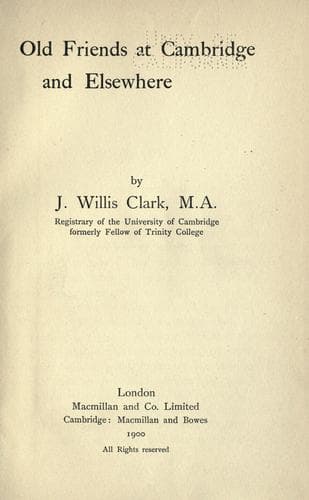
Old Friends at Cambridge and ElsewhereClark, John Willis
History
Old Friends at Cambridge and Elsewhere
Clark, John Willis
University of Cambridge -- History
He was a High Churchman, but a High Churchman with a difference. He
belonged to the school of Pusey and Liddon rather than to that of the
modern Ritualist, whose doings were as alien to his convictions and
feelings as those of the party whom he scornfully styled ‘those
Protestants.’ I have heard him called narrow and intolerant. I beg leave
to refer such detractors to the sermon preached by him on the Sunday
after the death of Frederick Denison Maurice. And this brings me to what
was, perhaps, the leading principle of his whole life—his absolute
honesty and fearlessness. He held certain beliefs and certain opinions
himself, which he cherished, and which were of vital importance to
himself; but he did not shut his eyes to the possibility that others who
held diametrically opposite views might be in the right also. And if he
found a man sincere, no considerations of party, of respectability, of
imaginary dangers concealed behind opinions held to be heretical, would
prevent him from speaking out and proclaiming his admiration.
In manners Luard had much of the stately courtesy which we commonly
ascribe to the last century, joined to a vivacious impulsiveness due, no
doubt, to his French extraction. This impulsiveness led him into a
rapidity of thought and utterance which often caused him to be
misunderstood. He said what came first into his thoughts, and corrected
it afterwards; but, unfortunately for him, people remembered the first
words used, and forgot the explanation. Hence he was often
misunderstood, and credited with opinions he did not really hold. He
delighted in society, and few men knew better how to deal with it, or
how to make his house an agreeable centre of Cambridge life. In this he
was ably seconded by his admirable wife, _qui savait tenir un salon_, as
the French say, more successfully than is usual in this country. Without
her help he would hardly have been able to find the time required for
his continual hospitalities. The house was different from any other
house that I have ever known, and reflected, more directly, the peculiar
gifts and tastes of its owner. The pictures, the china, the books that
lined the walls, bespoke the cultivated scholar; but the modern volumes
that lay on the tables showed that he was no dry archaeologist, but full
of enthusiasm for all that was best in modern literature. He had a keen
sense of humour, and an admirable memory; and when the conversation
turned that way, would tell endless stories of Cambridge life, or repeat
page after page of his favourite Thackeray. At the same time he did not
engross the conversation, but drew his guests out, and led each
insensibly to what was interesting to him or to her. It is sad to think
that all this has passed away; that exactly one month after Luard’s
death his friends stood again beside his grave to see his only child
laid in it; that his house will pass into alien hands; and that his
library will share the fate of similar collections. ‘_Eheu! quanto minus
Public-domain text, read in full here on John Shaqi.
Reviews
Reviews
No reviews yet
Be the first to share your thoughts on this work.
Elsewhere in the archive
Join the Discussion
Join the discussion
Sign in to leave a comment or review.
Sign InorCreate an account