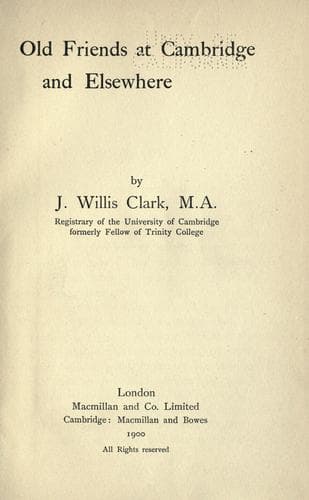
Old Friends at Cambridge and ElsewhereClark, John Willis
History
Old Friends at Cambridge and Elsewhere
Clark, John Willis
University of Cambridge -- History
Luard’s duties as Registrary, added to the continuous strain of his
historical work, would have been enough for most people; but he never
forgot that he was a clergyman, as well as a man of letters, and he took
care always to have some active clerical work to do. He was an eloquent
preacher, and his sermons in the College Chapel used to be listened to
with an interest that we did not always feel in what was said to us from
that pulpit. They were plain, practical, persuasive; the compositions of
one who was not above his congregation; who had nothing donnish about
him, but who spoke to the undergraduates as one who had passed through
the same temptations as themselves, and who was, therefore, in a
position to show them the right road. On the same principles, for the
twenty-seven years during which he was Vicar of Great S. Mary’s, he
laboured in the parish in a spirit of true sympathy. There was no
fussiness about him; he did not take part in movements; he did not
‘work’ a parish as a modern clergyman does, on the principle of
perpetual worry, leaving neither man, nor woman, nor child at peace for
a moment; he led his people to better things by gentle measures; he
sympathized with their troubles; he relieved their necessities; in a
word, he exercised an unbounded influence over them, while refraining
from interference in matters of moral indifference. His memory will long
be venerated there for active benevolence, and punctual discharge of all
that it became him to do. I have heard that the full extent of his
charities will never be known. He hated display, and avoided reference
to what he was about unless it was necessary to stimulate others by
mentioning it; but those who know best tell me that his labours among
the poor were unremitting, and that his generosity knew no limits.
Nor should it be forgotten, in even the most summary record of Luard’s
life at Cambridge, that it was he who got Great S. Mary’s restored in
the true sense of the word, by removing the excrescences which the
taste, or, rather, want of taste, of the last century had piled up in
it. He pulled down the carved work thereof—the hideous ‘Golgotha’—with
axes and hammers, and exhibited to an astonished and by no means
complacent University the noble church in the unadorned simplicity of
its architecture. The restoration of the University Church to something
like its ancient arrangement will be an enduring monument of his
parochial life.
Public-domain text, read in full here on John Shaqi.
Reviews
Reviews
No reviews yet
Be the first to share your thoughts on this work.
Elsewhere in the archive
Join the Discussion
Join the discussion
Sign in to leave a comment or review.
Sign InorCreate an account