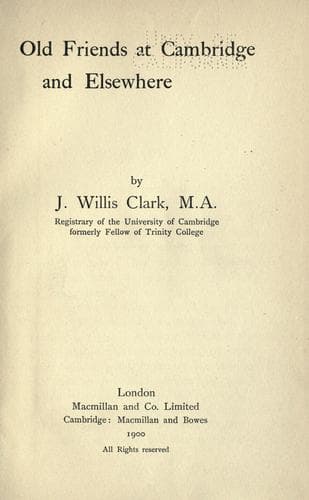
Old Friends at Cambridge and ElsewhereClark, John Willis
History
Old Friends at Cambridge and Elsewhere
Clark, John Willis
University of Cambridge -- History
We have no wish to underrate Owen’s brilliant talents, or his
perseverance, or his power of sustained work with a definite end in
view; but at the same time it would be absurd to deny that he had
good-fortune to thank for a large part of his first successes. What else
made Abernethy, at their first interview, give him just the appointment
best calculated to bring his peculiar gifts into the light of day? What
else made the same patron procure his appointment, two years later, as
assistant-conservator of the Hunterian collections, out of which all his
future celebrity was developed? He might have been ‘exceedingly well
informed in all that relates to his profession, an excellent anatomist,
and sober and sedate very far beyond any young man I ever knew,’ as one
who was in a position to know said of him in 1830, and yet have ‘bloomed
unseen,’ an obscure practitioner in ‘the dusky purlieus of the law,’ had
not the fickle goddess selected him as the special recipient of her
favours.
Owen’s active life in London divides itself naturally into two periods,
each containing nearly thirty years. The first, during which he was
connected with the Royal College of Surgeons, extended from 1827 to
1856; the second, during which he was nominally superintendent of the
biological side of the British Museum, from 1856 to 1883.
Those who would rightly understand his work during the former period
must of necessity take into account the history and extent of the vast
collection which he was expected to catalogue and to develop, for it
dominated and directed all his studies. It was formed by the celebrated
surgeon, John Hunter, between 1763 and 1793, in which year he died. In
studying it, one is at a loss what to admire most—the beauty of the
specimens themselves, and the admirable clearness with which those
preserved in spirit have been dissected and mounted; or the labour and
self-denial which brought them together in the midst of the incessant
occupations of a large practice; or the almost prophetic instinct which
divined what posterity would require in the way of such aids to study.
It was Hunter’s object to illustrate the phenomena of life in all
organisms, whether in health or in disease. For this purpose he
collected as widely as he could. There is an osteological series, and a
physiological series (in spirit), which exhibits the different organs,
digestive, circulatory, and the like, in order, and traces their
development from the simplest to the most complicated form. To the
Invertebrata he had devoted special attention. He had secured, through
his friend Sir Joseph Banks, many of the treasures collected during
Cook’s voyages; and he had purchased rarities as occasion offered. Of
insects he had a large collection. Nor were his observations limited to
the animal kingdom. Whenever any physiological process could be
illustrated by vegetable life, vegetables were pressed into the service.
Nor did he fail to recognize the truth—which some persons still refuse
Public-domain text, read in full here on John Shaqi.
Reviews
Reviews
No reviews yet
Be the first to share your thoughts on this work.
Elsewhere in the archive
Join the Discussion
Join the discussion
Sign in to leave a comment or review.
Sign InorCreate an account