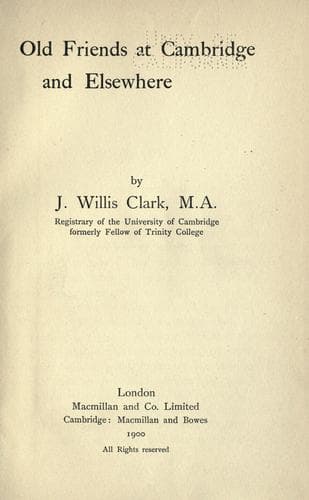
Old Friends at Cambridge and ElsewhereClark, John Willis
History
Old Friends at Cambridge and Elsewhere
Clark, John Willis
University of Cambridge -- History
to accept—that the remains of extinct animals are only in their proper
place when side by side with those still living on the earth. ‘His
collection of fossils,’ says Owen in one of his prefaces, ‘was the
largest and most select of any in this country.’
To contain this collection Hunter had built a special museum in Castle
Street, Leicester Square, which was open to public inspection on certain
days. After his death his executors, in accordance with his will,
offered the collection to the Government. ‘Buy preparations?’ exclaimed
Mr Pitt; ‘why, I have not money enough for gunpowder!’ Ultimately,
however, the House of Commons agreed to give £15,000 for it, just
one-fifth of the sum that Hunter is said to have spent upon it. Next
arose the further question, who should take care of it. The Royal
Society, it is said, did not consider it ‘an object of importance to the
general study of natural history’; the British Museum was literary, not
scientific; and finally, in 1799, the Corporation of Surgeons, as it was
then called, accepted it, under the condition that a proper catalogue
should be made, a conservator appointed, and twenty-four lectures in
explanation of it delivered annually in the college. Soon afterwards the
Corporation of Surgeons became the Royal College of Surgeons, and a
building, to which Parliament contributed £27,500, was built for its
reception. This was opened in 1813.
When Owen was appointed assistant-conservator of these collections
thirty-four years had elapsed since Hunter’s death. During that time
they had been preserved from damage by the devoted care of Mr William
Clift, who, after being Hunter’s assistant for a short time, had been
appointed conservator, first by the executors, and subsequently by the
college. The general arrangement had been prescribed by Hunter, but no
descriptive catalogue existed, as it had been, unfortunately, Hunter’s
habit to trust to his memory for the history of his specimens. Further,
though lists, more or less imperfect, drawn up either by Hunter himself
or under his direction, had been preserved, the bulk of his papers had
been destroyed by Sir Everard Home, his brother-in-law and executor.
‘There is but one thing more to be done—to destroy the collection,’ was
Clift’s remark when he heard of this act of cynical wickedness. In the
scarcity, therefore, of documentary evidence, other expedients had to be
resorted to for the identification of the specimens which Hunter had
dissected, or had preserved entire in spirit. As Owen remarks in the
preface to the first volume of his descriptive catalogue (published in
1833), ‘It was necessary to consult the book of Nature.’ At first it was
no easy matter to procure the animals required; but after the
establishment of the Zoological Society this difficulty was in a great
measure removed, and more than two hundred dissections were made by Owen
in the course of the work incident to the preparation of the first
volume of the catalogue.
Public-domain text, read in full here on John Shaqi.
Reviews
Reviews
No reviews yet
Be the first to share your thoughts on this work.
Elsewhere in the archive
Join the Discussion
Join the discussion
Sign in to leave a comment or review.
Sign InorCreate an account