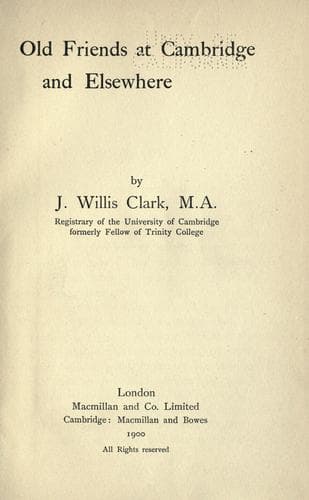
Old Friends at Cambridge and ElsewhereClark, John Willis
History
Old Friends at Cambridge and Elsewhere
Clark, John Willis
University of Cambridge -- History
This sketch of the Hunterian collections, which we would gladly have
worked out in greater detail had our space allowed us to do so, will
perhaps be sufficient to indicate to our readers the nature of the field
of research on which Owen was about to enter. It was, in fact, an
undiscovered country, of which he was to be the pioneer. One would like
to know whether he had any idea of what the work he was about to
undertake implied; and whether he had any misgivings as to his own
fitness for it. He was only twenty-three years old, so perhaps, as youth
is sanguine, he entered upon it with a light heart, thinking—if he
paused to think—that he had strength of will sufficient to compensate
for defect of years and knowledge. ‘On vieillit vite sur les champs de
bataille.’ His previous training must have been in the main
professional; he could have gained at most only a glimpse of comparative
anatomy at the feet of Dr Barclay; the great writers on the subject,
Buffon, Daubenton, Cuvier, and the rest, must have been mere names to
him. Moreover, he was obliged, for lucre’s sake, to continue the
profession of a surgeon, and, though he gradually dropped it, he must,
for some time at least, have spent a good deal of time over it. Besides
this, he probably assisted Clift in the brief catalogue of the Hunterian
collections that appeared between 1833 and 1840. But, while thus
engaged, he found time for study. For three years he attempted no
original work; and when he did begin to write (his first paper is dated
9 November, 1830), it is evident that the previous years had been spent
in wise preparation. There is no trace of the novice in the papers that
followed each other in quick succession; they evince a complete mastery
of the subject from the historical, as well as from the anatomical,
side. The mere number of these communications, addressed principally to
the Zoological Society, is almost past belief. Before the end of 1855
more than 250 had appeared, many of which were of considerable length,
and enriched with elaborate drawings made by himself. But what is more
surprising still is the versatility displayed in their composition.
Nowadays a biologist is compelled to specialize. By ‘the custom of the
country,’ to borrow a legal phrase, he selects his own subject, and is
expected not to poach on that of his neighbours. But when Owen began to
work, these laws existed not, or at any rate not for him. The very
nature of his work obliged him to study in quick succession the most
diverse structures; and, as death does not accommodate itself to human
convenience, he could not tell from day to day what animals would be
sent from the Zoological Gardens to his dissecting-room. An excellent
bibliography of his works at the end of the second volume of the _Life_
enables us to trace his studies in detail. For our present purpose we
will only point out that between 1831 and 1835 he had written papers
(among many others) on the orang-outang, beaver, Thibet bear, gannet,
Public-domain text, read in full here on John Shaqi.
Reviews
Reviews
No reviews yet
Be the first to share your thoughts on this work.
Elsewhere in the archive
Join the Discussion
Join the discussion
Sign in to leave a comment or review.
Sign InorCreate an account