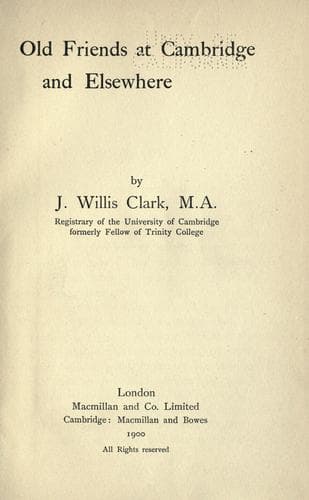
Old Friends at Cambridge and ElsewhereClark, John Willis
History
Old Friends at Cambridge and Elsewhere
Clark, John Willis
University of Cambridge -- History
Further, Owen had the opportunity of listening to some of the debates
between Cuvier and Geoffrey Saint-Hilaire on the question of how new
species may originate; and ‘on returning home,’ he adds, ‘I was guided
in all my work with the hope or endeavour to gain inductive ground for
conclusions on these great questions.’ Here, then, was the definite
educational result which Owen gained from his visit. It had, moreover,
another consequence. It made him known to the French naturalists, then
in the front rank of science. His scientific acquirements, coupled with
his agreeable manners and facility in speaking and writing French, made
him a _persona grata_ in Paris. In 1839 he was elected a corresponding
member of the Institute, and read more than one paper there in French.
We have already mentioned the long line of scientific papers which, from
1830 onwards, were the result of Owen’s indomitable energy. This series
was now to be interrupted for a moment by the famous _Memoir on the
Pearly Nautilus_, a quarto volume of sixty-eight pages, illustrated by
eight plates, drawn by himself. The shell of the nautilus, as most
persons know, has always been fairly common; but the animal which was
given to the Museum of the College of Surgeons in 1831 was, we believe,
the first, or nearly the first, which had ever reached this country, and
Owen was most fortunate in having the chance of describing such a
rarity. His essay, elaborate and exhaustive as it is, was dashed off in
less than a year. It was received with a general chorus of praise. Dr
Buckland spoke of it as ‘Mr Owen’s admirable work,’ and they were soon
in correspondence on the way in which the nautilus sinks and rises in
the water. Milne Edwards translated it into French, and Oken into
German. Nor has the contemporary verdict been reversed by that of
posterity. Mr Huxley says of the _Memoir_ that it
‘placed its author, at a bound, in the first rank of monographers. There
is nothing better in the _Mémoires sur les Mollusques_, I would even
venture to say nothing so good, were it not that Owen had Cuvier’s great
work for a model; certainly, in the sixty years that have elapsed since
the publication of this remarkable monograph it has not been excelled’
(ii. 306).
This essay seems to have given Owen a taste for the group to which the
nautilus belongs. At the conclusion of the _Memoir_ he proposed a new
arrangement of it, now generally accepted, which includes the fossil as
well as the recent forms; and, as occasion presented itself, he
described other species and genera. The merit of a memoir on the fossil
group called ‘belemnites,’ from the Oxford Clay, was the cause assigned
for the award to him of the gold medal of the Royal Society in 1846.
Public-domain text, read in full here on John Shaqi.
Reviews
Reviews
No reviews yet
Be the first to share your thoughts on this work.
Elsewhere in the archive
Join the Discussion
Join the discussion
Sign in to leave a comment or review.
Sign InorCreate an account