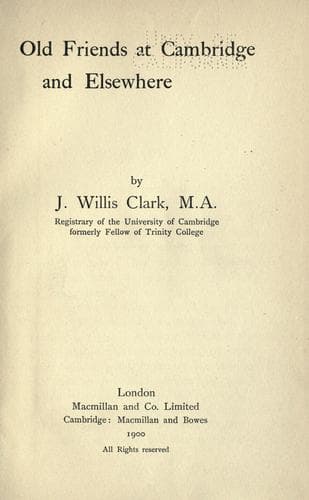
Old Friends at Cambridge and ElsewhereClark, John Willis
History
Old Friends at Cambridge and Elsewhere
Clark, John Willis
University of Cambridge -- History
Between 1833 and 1840 the long-desired catalogue, in five quarto
volumes, made its appearance. Sir William Flower calls it ‘monumental’;
a singularly happy epithet, for it commemorates, as a monument should
do, alike the founder of the Museum and the industrious anatomist who
had minutely described the four thousand specimens of which the
‘physiological series’—or, as we should now say, the series of
organs—then consisted. Nor, though the arrangement is obsolete, can the
work itself be regarded as without value, even at the present time. It
has already served as a model for the catalogues of many other museums,
and has taken its place in the literature of the subject. It is, in
fact, an elaborate treatise on comparative anatomy from the point of
view of the modifications of special organs. The thirteen years spent
over it can hardly appear an excessively long time when we remember the
work involved, and also the fact that the college had from the first
recognized the duty of filling up gaps in the collection as occasion
offered. Many of the specimens recorded in this catalogue had been
prepared by Owen himself.
During the years that Owen spent upon the catalogue his position at the
College of Surgeons was gradually becoming assured. He had begun as
assistant-curator at £120 a year, but with no prospects, as the place of
curator was expected to be given to Mr Clift’s son on his father’s
retirement. But in 1832 the younger Clift died suddenly from the effects
of an accident, and Owen remained as sole assistant at £200. In July
1833 his salary was raised to £300, and in 1835 he was enabled to marry
Caroline Clift, Mr Clift’s only daughter. From this time until 1852,
when the Queen gave him the delightful cottage at Sheen which he lived
in till his death, he had apartments within the building of the College
of Surgeons. They were small, and inconvenient in many ways. Owen was in
the habit of turning his study into a dissecting-room, and his wife’s
diary contains many amusing references to the pervading odours caused by
the examination of a rhinoceros or an elephant, or to such disturbances
as the following: ‘Great trampling and rushing upstairs past our bedroom
door. Asked Richard if the men were dancing the polka on the stairs. He
said, “No; what you hear is the body being carried upstairs. They are
dissecting for fellowship to-day!”’ But, on the other hand, the
proximity to the library and the museum, which he could enter at any
hour of the night or day, must have greatly helped one who worked so
incessantly. Ultimately, in 1842, Owen became sole curator, with Mr
Quekett as his assistant. This was, no doubt, a dignified position, but
it had its drawbacks. Owen’s golden time at the college was the period
between 1827 and 1842, when the business details were taken off his
hands by the painstaking and methodical Clift. After 1842 he was held
responsible, as curators usually are, for much that he regarded as
irksome routine.
Public-domain text, read in full here on John Shaqi.
Reviews
Reviews
No reviews yet
Be the first to share your thoughts on this work.
Elsewhere in the archive
Join the Discussion
Join the discussion
Sign in to leave a comment or review.
Sign InorCreate an account