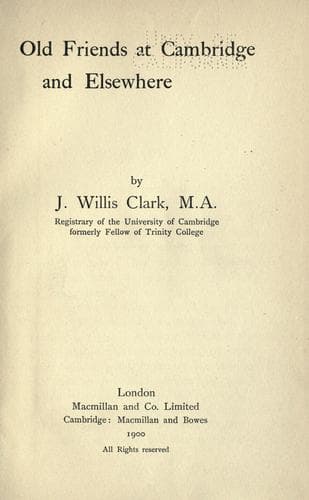
Old Friends at Cambridge and ElsewhereClark, John Willis
History
Old Friends at Cambridge and Elsewhere
Clark, John Willis
University of Cambridge -- History
Two years later, in 1839, a second and still more sensational
_trouvaille_ came into his hands. A fragment of bone was offered for
sale to the College of Surgeons, with the statement that it had been
obtained in New Zealand from a native, who said that it was the bone of
a great extinct eagle. Out of this fragment there ultimately grew that
phalanx of huge extinct birds to which Owen gave the name of _Dinornis_
(bird of wonder), on which he occupied himself till his death. His
recognition of the true origin of this fragment was, no doubt, a
wonderful instance of his osteological sagacity; but it is a
misrepresentation of fact to say that he evolved the whole of an extinct
bird out of a fragment of bone six inches long. What he did do, and how
he did it, shall be told in his own words:
‘As soon as I was at leisure I took the bone to the skeleton of the ox,
expecting to verify my first surmise [that it was a marrow-bone, like
those brought to table wrapped in a napkin]; but, with some resemblance
to the shaft of the thigh-bone, there were precluding differences. From
the ox’s humerus, which also affords the tavern delicacy, the
discrepancy of shape was more marked. Still, led by the thickness of the
wall of the marrow-cavity, I proceeded to compare the bone with
similar-sized portions of the skeletons of the various quadrupeds which
might have been introduced and have left their remains in New Zealand;
but it was clearly unconformable with any such portions.
‘In the course of these comparisons I noted certain obscure superficial
markings on the bone, which recalled to mind similar ones which I had
observed on the surface of the long bones in some large birds. Thereupon
I proceeded with it to the skeleton of the ostrich. The bone tallied in
point of size with the shaft of the thigh-bone in that bird, but was
markedly different in shape. There were, however, the same superficial
reticulate impressions on the ostrich’s femur which had caught my
attention in the exhaustive comparison previously made with the
mammalian bones.
‘In short, stimulated to more minute and extended examinations, I
arrived at the conviction that the specimen had come from a bird, that
it was the shaft of a thigh-bone, and that it must have formed part of
the skeleton of a bird as large as, if not larger than, the full-sized
male ostrich, with this more striking difference, that whereas the femur
of the ostrich, like that of the rhea and eagle, is pneumatic, or
contains air, the present huge bird’s bone had been filled with marrow,
like that of a beast[121].’
Public-domain text, read in full here on John Shaqi.
Reviews
Reviews
No reviews yet
Be the first to share your thoughts on this work.
Elsewhere in the archive
Join the Discussion
Join the discussion
Sign in to leave a comment or review.
Sign InorCreate an account