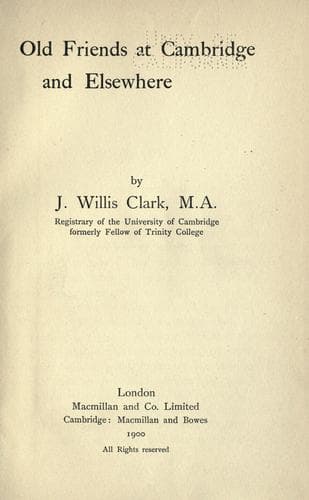
Old Friends at Cambridge and ElsewhereClark, John Willis
History
Old Friends at Cambridge and Elsewhere
Clark, John Willis
University of Cambridge -- History
These lectures, more than anything that he wrote, made Owen famous, and
procured for him a passport into society. To understand this, which
appears almost a phenomenon at the present day, it must be remembered
that the lecture-mania had not become one of the common diseases of
humanity in 1836, and that it was still considered proper for great
people to play the part of Mecenas to those who were distinguished in
science or in letters. Hence, when the news spread abroad that a young
and hitherto unknown lecturer was discoursing eloquently on a new
subject in a building which few had heard of and none had seen,
curiosity carried fashion into Lincoln’s Inn Fields, and certain dukes
and earls, who cultivated a taste for natural history _dans leur moments
perdus_, set the example of sitting at the feet of the new Gamaliel;
more serious persons followed, and by-and-by a Hallam, a Carlyle, and a
Wilberforce might be seen there side by side with the lights of medicine
and surgery.
To most men the work which these lectures, together with the catalogue,
entailed, would have been sufficient. But Owen loved diversity of
occupations; and one of his fortunate accidents presently threw an
attractive paleontological subject in his way. It happened in this wise.
Readers of the _Life of Charles Darwin_ will remember his
disappointment, on his return home from the now classic voyage of the
_Beagle_, to find that zoologists cared but little for his collections;
that, in fact, Lyell and Owen were the only two who wished to possess
any of his specimens. The latter, who had been introduced to him by the
former, was not slow to grasp the scientific value of the extinct
animals whose bones Darwin had dug with his own hands out of the
fluviatile deposits of South America. He began with a huge skull—‘the
head of an animal equalling in size the hippopotamus’—and described it
before the Geological Society, in 1837, under the name of _Toxodon
platensis_. Further, as Mr Huxley points out:
‘It is worthy of notice, that in the title of this memoir there follow,
after the name of the species, the words “referable by its dentition to
the Rodentia, but with affinities to the Pachydermata and the
herbivorous Cetacea,” indicating the importance in the mind of the
writer of the fact that, like Cuvier’s _Anoplotherium_ and
_Paleotherium_, _Toxodon_ occupied a position between groups which, in
existing Nature, are now widely separated’ (ii. 308).
The same writer bids us remark that this ‘maiden essay in paleontology
possesses great interest’ from another point of view, for ‘it is with
reference to Owen’s report on _Toxodon_ that Darwin remarks in his
_Journal_: “How wonderfully are the different orders, at the present
time so well separated, blended together in different points in the
structure of _Toxodon_.”’ Soon afterwards Owen described the rest of
Darwin’s fossil specimens in the geological part of _The Zoology of the
‘Beagle’ Voyage_.
Public-domain text, read in full here on John Shaqi.
Reviews
Reviews
No reviews yet
Be the first to share your thoughts on this work.
Elsewhere in the archive
Join the Discussion
Join the discussion
Sign in to leave a comment or review.
Sign InorCreate an account