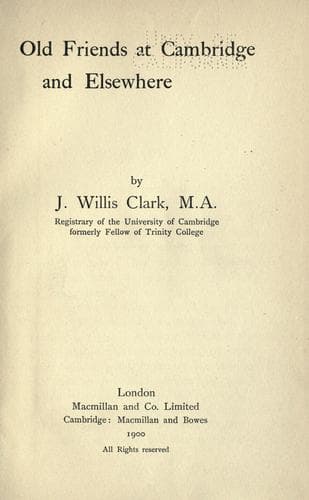
Old Friends at Cambridge and ElsewhereClark, John Willis
History
Old Friends at Cambridge and Elsewhere
Clark, John Willis
University of Cambridge -- History
‘Owen was tall and ungainly in figure, with massive head, lofty
forehead, curiously round, prominent, and expressive eyes, high
cheek-bones, large mouth, and projecting chin, long, lank, dark hair,
and, during the greater part of his life, smooth-shaven face and very
florid complexion.’
His manners were distinguished for ceremonious courtesy, coupled with
the formal exactness of a punctilious Frenchman. His bows were not
easily forgotten. His enemies said, and his friends could not deny, that
they varied with the rank of the person to whom he was presented. In
fact Owen might have said, with Sir Pertinax Macsycophant, ‘I naver in
my life could stond straight i’ th’ presence of a great mon; but awways
boowed, and boowed, and boowed, as it were by instinct.’
Next to what he called ‘my dear comparative anatomy,’ Owen loved music,
and was at one time no mean performer, both vocally and instrumentally.
Music was his constant recreation in an evening, and he has even been
known to take his violoncello out with him to parties. He was a frequent
attendant at concerts and operas, and when Weber’s _Oberon_ was first
performed in London he went to hear it thirty nights in succession. The
stage also had attractions for him, and he and his wife had many friends
in the dramatic profession. Macready in _Henry the Fifth_, Charles Kean
in _Louis XI._ and _Richard III._, and many minor stars, gave him great
pleasure; and it was on the stage of Drury Lane Theatre, while joining
the actors in singing the National Anthem on the occasion of the Queen’s
first state visit, that he met Charles Dickens, who afterwards became
his intimate friend. ‘London,’ he once said, ‘is the place for
interchange of thought’; and it was a relief to him to lay his habitual
pursuits aside for a few hours, and exchange ideas with men whose lives
lay in lines wholly different from his own. He found dining-out a
relaxation—the hours were earlier in those days—and gradually, as his
social gifts were discovered, he was much in request. No man could tell
a story better, and his general conversation was brilliant and original.
He had the happy art of dilating on his own pursuits without being
either a pedant or a bore. Consequently he was a member of many
societies who, ‘greatly daring, dined,’ as, for instance, the Abernethy
Club, the Literary Society, and The Club, founded by Dr Johnson, an
exclusive society limited to forty members, in which he occupied the
place once filled by Oliver Goldsmith. He also promoted the Royal
Literary Fund and the Actors Benevolent Fund—where his after-dinner
eloquence was much appreciated. He was a good chess-player, and was
often matched, successfully, with some of the first players of the day,
as Landseer, Staunton, and the Duke of Brunswick. His acquaintance with
literature was wider than might have been expected from his absorbing
occupations in other directions, and his retentive memory enabled him to
Public-domain text, read in full here on John Shaqi.
Reviews
Reviews
No reviews yet
Be the first to share your thoughts on this work.
Elsewhere in the archive
Join the Discussion
Join the discussion
Sign in to leave a comment or review.
Sign InorCreate an account