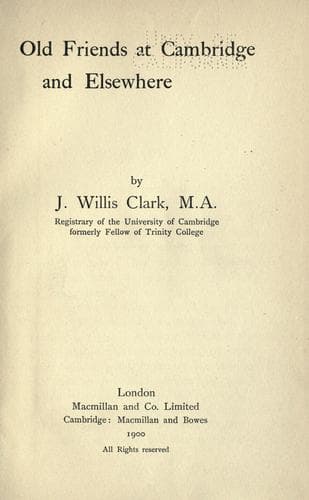
Old Friends at Cambridge and ElsewhereClark, John Willis
History
Old Friends at Cambridge and Elsewhere
Clark, John Willis
University of Cambridge -- History
quote pages of Milton, Shakespeare, and other standard writers. He was
also an ardent novel-reader. Mrs Owen kept him well supplied with the
novels of the day; and he sat up half the night over _Eugene Aram_, the
serial stories of Dickens, _Vanity Fair_, _Shirley_, and _The Mill on
the Floss_, which we are glad to find he preferred to all the rest of
George Eliot’s stories. Apart from his social proclivities, he managed
to get acquainted with most of the celebrated people of the day. They
either came to see him and the museum he directed, or they asked him to
call on them. Among those whom he met in this way we may mention Mrs
Fry, Miss Edgeworth, Turner, Samuel Warren, Emerson, Guizot, the younger
Dumas, Fanny Kemble, Tennyson, Macaulay, and Carlyle, who described him
as ‘the man with the glittering eyes,’ and decided that he was ‘neither
a fool nor a humbug.’ In his own especial line of science he was
intimate with Lord Enniskillen, Sir Philip Egerton, Prince Lucien
Bonaparte, Sedgwick, Murchison, Lyell; and subsequently took a keen
interest in the researches of Livingstone, whom he helped with the first
record of his African work. ‘Poor Livingstone!’ he says; ‘he does not
know what it is to write a book.’ When Owen could find time for a
holiday, which was but seldom, he enjoyed fishing and grouse-shooting;
but his delight in Nature was so keen that probably sport was what he
least valued in these excursions.
It was natural that, as Owen’s reputation grew, he should be involved in
some of the schemes for improving the condition of the people which from
time to time engaged the attention of Government. In 1843 he served on a
commission of inquiry into the health of towns, and exercised himself
over sewers, slaughter-houses, and such-like abominations. In 1846 he
was on the Metropolitan Sewers Commission, which grew out of the former,
and he did much good work in hunting up evidence about the spread of
cholera and typhus from imperfect drainage. In the course of this he
incurred considerable unpopularity, and was contemptuously nick-named
‘Jack of all Trades.’ The work became so heavy and absorbing that he
thought of resigning; but when Lord Morpeth urged him to remain, on the
ground that they could ill spare his ‘enlightened philanthropy,’ he not
only withdrew his resignation, but consented to serve on a commission to
consider the state of Smithfield Market and the meat supply of London
(1849), a subject on which he held very decided opinions. Probably his
zoological qualifications, coupled with his knowledge of what had been
effected on the Continent in the way of establishing extramural
slaughter-houses, had much to do with abolishing the market. He was also
on the Preliminary Committee of Organization for the Great Exhibition of
1851, and chairman of the jury on raw materials, alimentary substances,
&c. Similar services were performed by him for the exhibition held at
Paris in 1855.
Public-domain text, read in full here on John Shaqi.
Reviews
Reviews
No reviews yet
Be the first to share your thoughts on this work.
Elsewhere in the archive
Join the Discussion
Join the discussion
Sign in to leave a comment or review.
Sign InorCreate an account