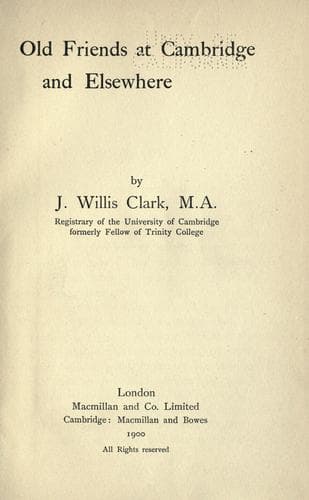
Old Friends at Cambridge and ElsewhereClark, John Willis
History
Old Friends at Cambridge and Elsewhere
Clark, John Willis
University of Cambridge -- History
At the end of the third volume of the _Anatomy_ are some ‘General
Conclusions,’ which contain, so far as human intelligence can penetrate
the meaning of Owen’s ‘dark speech,’ his final views on the origin of
species. We have already shown that his mind was first turned to this
momentous question during his visit to Paris in 1831, and that
subsequently, during his work on the Physiological and Osteological
Catalogues of the Museum of the College of Surgeons, it was continually
in his thoughts. During this period he read, and was profoundly
influenced by, Oken’s _Lehrbuch der Naturphilosophie_, a translation of
which was published by the Ray Society, in 1847, at his instance. In his
_Archetype and Homologies of the Vertebrate Skeleton_ (1848) he says:
‘The subject of the following essay has occupied a portion of my
attention from the period when, after having made a certain progress in
comparative anatomy, the evidence of a greater conformity to type,
especially in the bones of the head of the vertebrate animals, than the
immortal Cuvier had been willing to admit, began to enforce a
reconsideration of his conclusions, to which I had previously yielded
implicit assent.’
Out of the study here indicated there grew a revision of the vertebrate
skeleton, in which the homologues (_i.e._ the same organs in different
animals, under every variety of form and function) were recognized, and
a new system of osteological nomenclature was proposed. In this Owen did
excellent work, which has been generally accepted. But in his anxiety to
recognize and account for ‘the one in the many,’ he adopted Oken’s idea
of the skeleton being resolvable into a succession of vertebræ, and
evolved the idea of an archetype. It is almost inconceivable that the
clear-headed and sagacious interpreter, whose sober conclusions we have
indicated through a long series of zoological and paleontological
memoirs, should have ever adopted these transcendental speculations. But
there was evidently a metaphysical side to his mind, and he took a keen,
almost a puerile, delight in this child of his fancy. He even had a seal
engraved with a symbolical representation of it. To show that we are not
exaggerating we will quote his own account of his views when sending the
seal to his sister:
‘It represents the archetype, or primal pattern—what Plato would have
called the “Divine Idea”—on which the osseous frame of all vertebrate
animals has been constructed. The motto is “The One in the Manifold,”
expressive of the unity of plan which may be traced through all the
modifications of the pattern, by which it is adapted to the varied
habits and modes of life of fishes, reptiles, birds, beasts, and human
kind. Many have been the attempts to discover the vertebrate archetype,
and it seems now generally felt that it has been found’ (i. 388).
Public-domain text, read in full here on John Shaqi.
Reviews
Reviews
No reviews yet
Be the first to share your thoughts on this work.
Elsewhere in the archive
Join the Discussion
Join the discussion
Sign in to leave a comment or review.
Sign InorCreate an account