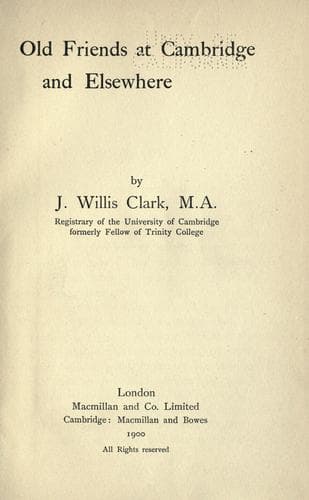
Old Friends at Cambridge and ElsewhereClark, John Willis
History
Old Friends at Cambridge and Elsewhere
Clark, John Willis
University of Cambridge -- History
‘I never heard so thoroughly eloquent a lecture as that of yesterday....
It is the first time I have had the pleasure of seeing our British
Cuvier in his true place, and not the less delighted to listen to his
fervid and convincing defence of the principle laid down by his great
precursor. Everyone was charmed, and he will have done more (as I felt
convinced) to render our institution favourably known than by any other
possible method’ (ii. 61).
Soon afterwards he was appointed (1859-61) Fullerian Professor of
Physiology at the Royal Institution. Here again he chose ‘Fossil
Mammals’ as his subject. In later years he gave frequent lectures on
this and kindred subjects in the larger provincial towns. Nor must we
omit the lectures to the Royal children at Buckingham Palace, which he
delivered at the request of Prince Albert in 1860. These lectures, which
were much appreciated by those for whom they were intended, laid the
foundations of a close friendship between Owen and the Royal Family.
It must not, however, be supposed that these occupations diverted him
from osteology. It was during this period that he wrote many of the
paleontological memoirs to which we have already alluded. He continued
to publish paper after paper on _Dinornis_ as fresh material
accumulated; and he composed, among others, his monograph on the Aye-Aye
(1863), which perhaps excited as much attention as that on the Nautilus
thirty years before.
Between 1866 and 1868 he published his elaborate treatise _On the
Anatomy of Vertebrates_, obviously intended to be the standard work on
the subject for all time. But alas for the fallacies of hope! It is an
immense store-house of information, founded in the main upon his own
observations and dissections; and from no similar work will advanced
students derive so much assistance. But, unfortunately, no revision of
his own papers was attempted; the novel classification employed has
never been accepted by any school of zoologists; and the only result of
the proposed division of the Mammalia into four sub-classes, according
to their cerebral characteristics, was a controversy from which Owen
emerged with his reputation for scientific accuracy seriously impaired,
if not irretrievably ruined. He had stated, not merely in the work of
which we are speaking, but in others—as, for instance, in the Rede
Lecture delivered at Cambridge in 1859—that certain divisions of the
human brain were absent in the apes. It was proved over and over again,
in public and private, that this assertion was contrary to fact, and
contrary to his own authorities; but he could never be persuaded to
retract, or even to modify, his statements.
Public-domain text, read in full here on John Shaqi.
Reviews
Reviews
No reviews yet
Be the first to share your thoughts on this work.
Elsewhere in the archive
Join the Discussion
Join the discussion
Sign in to leave a comment or review.
Sign InorCreate an account