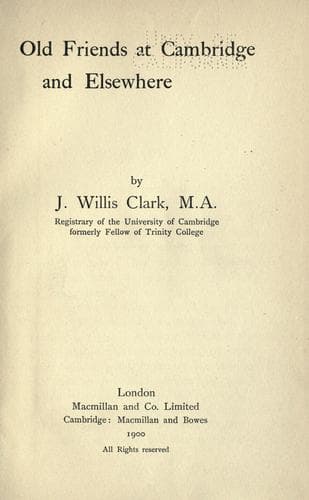
Old Friends at Cambridge and ElsewhereClark, John Willis
History
Old Friends at Cambridge and Elsewhere
Clark, John Willis
University of Cambridge -- History
Whewell’s wish to develop Professorial tuition has been already alluded
to. It may be doubted if he would have been so earnest on the subject
had he foreseen the development of teaching by the University as opposed
to teaching by the colleges, which a large increase in the number of
Professors was certain to bring about. So far back as 1828, he had
brought before the University the want of proper lecture-rooms and
museums; and, as a matter of course, he promoted the erection of the
present museums in 1863. We are justified, therefore, in claiming for
him no inconsiderable share in that development of natural science which
is one of the glories of Cambridge; and when we see the crowds which
throng the classes of the scientific professors, lecturers, and
demonstrators, we often wish that he could have been spared a few years
longer to enter into the fruit of his labours.
As regards the constitution of the University he earnestly deprecated
the interference of a Commission. He held that ‘University reformers
should endeavour to reform by efforts within the body, and not by
calling in the stranger.’ He therefore worked very hard as a member of
what was called the ‘Statutes Revision Syndicate,’ first appointed in
1849, and continued in subsequent years. His views on these important
matters have been recorded by him in his work on a Liberal Education. It
is worth remarking that while he was in favour of so advanced a step as
making College funds available for University purposes, he strenuously
maintained the desirability of preserving that ancient body, the
_Caput_. One of the most vexatious provisions of its constitution was
that each member of it had an absolute veto on any grace to which he
might object. As the body was selected, the whole legislative power of
the University was practically vested in the Heads of Houses, who are
not usually the persons best qualified to understand the feeling of the
University. Dr Whewell has frequently recorded, in his correspondence,
his vexation when graces proposed by himself were rejected by this body;
and yet, though he knew how badly the constitution worked, his
attachment to existing forms was so great, that he could not be
persuaded to yield on any point except the mode of election.
Public-domain text, read in full here on John Shaqi.
Reviews
Reviews
No reviews yet
Be the first to share your thoughts on this work.
Join the Discussion
Join the discussion
Sign in to leave a comment or review.
Sign InorCreate an account