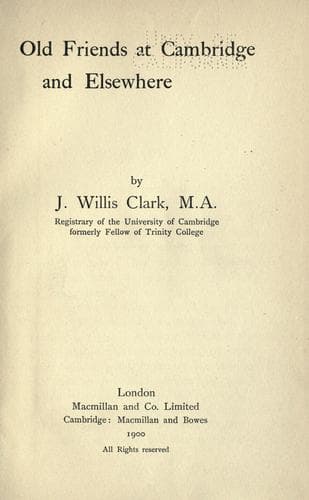
Old Friends at Cambridge and ElsewhereClark, John Willis
History
Old Friends at Cambridge and Elsewhere
Clark, John Willis
University of Cambridge -- History
contradictory to reason and common sense that a population of one
hundred persons should have two representatives, while four hundred
thousand are without one. These are abuses which require speedy
correction[28].’ He had evidently been taken to see Cambridge, and was
constantly looking forward to his residence there. His anticipations,
however, were not wholly agreeable. At that time he did not care much
for classics. He thought that they were not ‘objects of such infinite
importance that the most valuable portion of man’s life, the time which
he passes at school and at college, should be devoted to them.’ In
after-life he said that he had been ‘injudiciously plied with Horace at
the Charterhouse,’ and that, in consequence, ‘many years elapsed before
I could enjoy the most charming of Latin poets[29].’ He admits, however,
that he is looking forward ‘with hope and pleasing anticipation to the
time when I shall immure myself’ at Cambridge; and he makes some really
admirable reflections, most unusual at that period, on University
distinctions and the use to be made of them:
‘There is one particular in which I hope to differ from many of those
envied persons who have attained to the most distinguished academical
honours. Several of these seem to have considered the years which they
have spent at the University, not as the time of preparation for studies
of a more severe and extended nature, but as the term of their labours,
the completion of which is the signal for a life of indolence,
dishonourable to themselves and unprofitable to mankind. Literature and
science are thus degraded from their proper rank, as the most dignified
occupations of a rational being, and are converted into instruments for
procuring the gratification of our sensual appetites. This will not, I
trust, be the conduct of your friend. Sorry indeed should I be to accept
the highest honours of the University were I from that time destined to
sink into an obscure and useless inactivity[30].’
An English translation of the _Pensées_ of Pascal had fallen in his way;
and, in imitation of that great thinker, he had formed a resolution, of
which he begs his friend to remind him in future years, to devote
himself wholly to such studies (among others to the acquisition of a
knowledge of Hebrew) as would fit him for the clerical profession. We
shall see that he never really faltered from these intentions; for,
though he was at one time beset with doubts as to his fitness to perform
the practical duties of a clergyman, he was from first to last a
theologian, and only admitted other studies as ancillary to that central
object.
Public-domain text, read in full here on John Shaqi.
Reviews
Reviews
No reviews yet
Be the first to share your thoughts on this work.
Join the Discussion
Join the discussion
Sign in to leave a comment or review.
Sign InorCreate an account