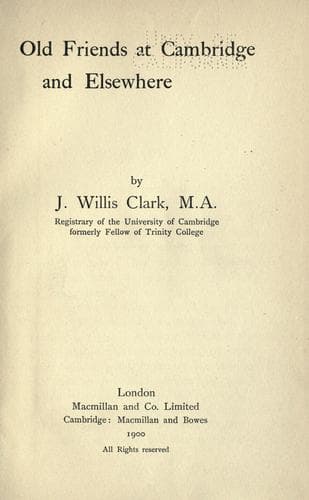
Old Friends at Cambridge and Elsewhere — John Shaqi
Old Friends at Cambridge and ElsewhereClark, John Willis
History
Old Friends at Cambridge and Elsewhere
Clark, John Willis
University of Cambridge -- History
It will easily be imagined that these proceedings were watched with the
greatest interest at Cambridge. Public opinion had risen to fever-heat,
and a plentiful crop of pamphlets was the result. It is difficult
nowadays to read without a smile these somewhat hysterical productions,
with their prophecies of untold evils to come, should the fatal measure
suggested by the petitioners ever pass into the Statute-book. Among
these pamphlets that which most concerns our present purpose was by Dr
Thomas Turton, then Regius Professor of Divinity, and afterwards Lord
Bishop of Ely, entitled, _Thoughts on the Admission of Persons, without
regard to their Religious Opinions, to certain Degrees in the
Universities of England_. Dr Turton was universally respected, and his
pamphlet attracted great attention on that account, and also from the
ability and ingenuity of the argument. He adopted the comparative
method; and endeavoured to prove that evils would ensue from the
intercourse of young men who differed widely from one another in
theological beliefs, by tracing the history of the Theological Seminary
for Nonconformists, commenced by the celebrated Dr Doddridge, in 1729,
at Northampton, and subsequently removed to Daventry in 1751. The
gauntlet thus thrown down was taken up by Thirlwall, who lost but little
time in addressing to him a _Letter on the Admission of Dissenters to
Academical Degrees_. After stating briefly that what he was about to say
would be said on his own responsibility, and that he did not come
forward as ‘the organ or advocate’ of those who had taken the same side
as himself, many of whom, he thought, would not agree with him, he
proceeded to attack the analogy between Cambridge and Daventry which Dr
Turton had attempted to establish. ‘Our colleges,’ he boldly asserted,
‘are not theological seminaries. We have no theological colleges, no
theological tutors, no theological students.’ The statement was
literally true; it might even be said to be as capable of demonstration
as any simple mathematical proposition; but uttered in that way, in a
controversial pamphlet, in support of a most unpopular cause, it must
have sounded like the blast of a hostile trumpet. This, however, was not
all. Dr Turton had claimed for the Universities the same privilege which
was enjoyed by Nonconformists, viz. the possession of colleges where
‘those principles of religion alone are taught which are in agreement
with their own peculiar views.’ Thirlwall, therefore, proceeded to
inquire whether the colleges, though not theological seminaries, might
be held to be schools for religious instruction. This question again he
answered in the negative; and his opponent having placed in the foremost
rank among the privileges long exercised by the Universities (1) the
relation of tutor to pupil, (2) the chapel services, (3) the college
lectures, he proceeded to examine whether these could ‘properly be
numbered among the aids to religion which this place furnishes.’ To him
Public-domain text, read in full here on John Shaqi.
Reviews
Reviews
No reviews yet
Be the first to share your thoughts on this work.
Join the Discussion
Join the discussion
Sign in to leave a comment or review.
Sign InorCreate an account