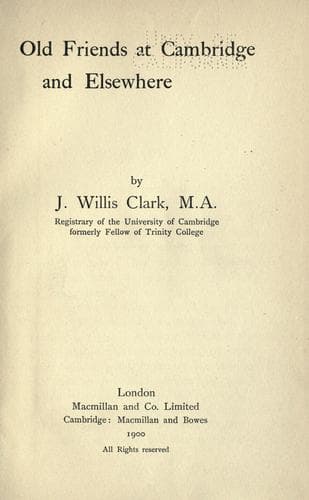
Old Friends at Cambridge and ElsewhereClark, John Willis
History
Old Friends at Cambridge and Elsewhere
Clark, John Willis
University of Cambridge -- History
‘Even if I had laid claim to oracular wisdom I should have thought this
complaint rather unreasonable; for the oracle at Delphi, though it
pretended to divine infallibility, was used to wait for a question
before it gave a response. But I wish above all things to be sure as to
the person with whom I have to do. I remember to have read of one who
went to the oracle at Delphi, “ex industriâ factus ad imitationem
stultitiæ”; and I cannot help suspecting that I have before me one who
has put on a similar disguise. The voice does not sound to me like that
of a “mountain clergyman”; while I look at the roll I seem to recognize
a very different and well-known hand. The “difficulties” are very unlike
the expression of an embarrassment which has been really felt, but might
have been invented in the hope of creating one. They are quite worthy of
the mastery which you have attained in the art of putting questions, so
as most effectually to prevent the possibility of an answer[71].’
But if Thirlwall’s great merits were not fully appreciated in his own
diocese, there was no lack of recognition of them in the Church at
large. His seclusion at Abergwili largely increased his influence. It
was known that he thought out questions for himself, without consulting
his episcopal brethren or his friends, and without being influenced in
any way, as even the most conscientious men must be, in despite of
themselves, by the opinions which they hear expressed in society. Hence
his utterances came to be accepted as the decisions of a judge; of one
who, standing on an eminence, could take ‘an oversight of the whole
field of ecclesiastical events[72],’ and from that commanding position
could distinguish what was of permanent importance from that which
possessed a merely controversial interest as a vexed question of the
day. We have spoken of the advantages which he derived from his secluded
life; it must be admitted that it had also certain disadvantages. The
freshness and originality of his opinions, the judicial tone of his
independent decisions, gave them a permanent value; but his want of
knowledge of the opinions of those from whom he could not wholly
dissociate himself, and, we may add, his indifference to them, caused
him to be not unfrequently misunderstood, and to be charged with holding
views not far removed from heresy. ‘I will not call him an unbeliever,
but a misbeliever,’ said a very orthodox bishop, whose love of epigram
occasionally got the better of his charity. His brother bishops, like
the Welsh clergy, feared him more than they loved him; they knew his
value as an ally, but they knew also that he would never, under any
circumstances, become a partisan, or adopt a view which he could not
wholly approve, merely because it seemed good to his Order to exhibit
unanimity. It was probably for this reason, as much as for his eloquence
and power, that he had the ear of the House of Lords on the rare
occasions when he addressed it.
Public-domain text, read in full here on John Shaqi.
Reviews
Reviews
No reviews yet
Be the first to share your thoughts on this work.
Elsewhere in the archive
Join the Discussion
Join the discussion
Sign in to leave a comment or review.
Sign InorCreate an account