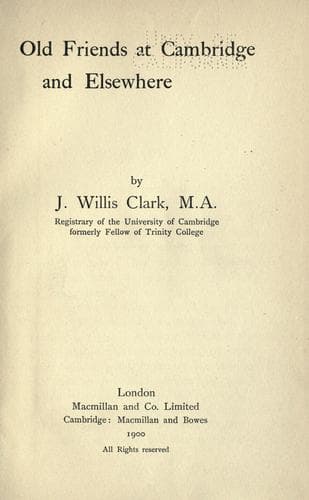
Old Friends at Cambridge and ElsewhereClark, John Willis
History
Old Friends at Cambridge and Elsewhere
Clark, John Willis
University of Cambridge -- History
The Peers knew that they were listening
to a man who had the fullest sense of the responsibilities of the
episcopate, but who would neither defend nor oppose a measure because
‘the proprieties’ indicated the side on which a bishop would be expected
to vote. Two only of his speeches are republished in the collection
before us—on the Civil Disabilities of the Jews (1848), and on the
Disestablishment of the Irish Church (1869). We should like to have had
added to these that on the grant to the Roman Catholic College of
Maynooth (1845), which seems to us to be equally worth preserving. On
these occasions Bishop Thirlwall took the unpopular side at periods of
great excitement; his arguments were listened to with the utmost
attention; and in the case of the Irish Church it has been stated that
no speech had a greater effect in favour of the measure than his.
In all Church matters he was a thorough Liberal. His view of the Church
of England cannot be better stated than by quoting a passage from one of
his _Letters to a Friend_. He had been reading Mr Robertson’s sermons;
and after saying that their author was specially recommended to him by
the hostility of the _Record_, ‘which I consider as a proof of some
excellence in every one who is its object,’ he thus proceeds:
‘He was certainly not orthodox after the _Record_ standard, but might
very well be so after another. For our Church has the advantage—such I
deem it—of more than one type of orthodoxy: that of the High Church,
grounded on one aspect of its formularies; that of the Low Church,
grounded on another aspect; and that of the Broad Church, striving to
take in both, but in its own way. Each has a right to a standing-place,
none to exclusive possession of the field. Of course this is very
unsatisfactory to the bigots of each party—at the two extremes. Some
would be glad to cast the others out; and some yearn after a Living
Source of Orthodoxy, of course on the condition that it sanctions their
own views. To have escaped that worst of evils ought, I think, to
console every rational Churchman for whatever he finds amiss at
home.’[73]
Public-domain text, read in full here on John Shaqi.
Reviews
Reviews
No reviews yet
Be the first to share your thoughts on this work.
Elsewhere in the archive
Join the Discussion
Join the discussion
Sign in to leave a comment or review.
Sign InorCreate an account