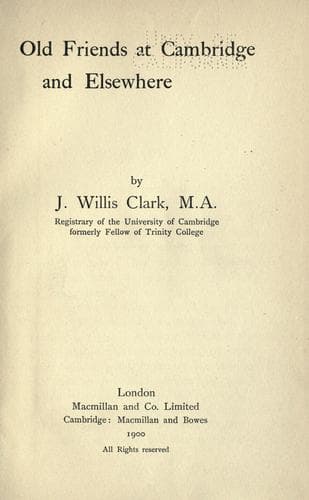
Old Friends at Cambridge and ElsewhereClark, John Willis
History
Old Friends at Cambridge and Elsewhere
Clark, John Willis
University of Cambridge -- History
‘There was Tennyson, the Laureate, whose goodly bay-tree decorates our
language and our land; Arthur, the younger Hallam, the subject of _In
Memoriam_, the poet and his friend passing, linked hand in hand,
together down the slopes of fame. There was Trench, the present
Archbishop of Dublin, and Alford, Dean of Canterbury, both profound
Scriptural philologists who have not disdained the secular muse. There
was Spedding, who has, by a philosophical affinity, devoted the whole of
his valuable life to the rehabilitation of the character of Lord Bacon;
and there was Merivale, who—I hope by some attraction of repulsion—has
devoted so much learning to the vindication of the Cæsars. There were
Kemble and Kinglake, the historian of our earliest civilization and of
our latest war—Kemble as interesting an individual as ever was portrayed
by the dramatic genius of his own race; Kinglake, as bold a man-at-arms
in literature as ever confronted public opinion. There was Venables,
whose admirable writings, unfortunately anonymous, we are reading every
day, without knowing to whom to attribute them; and there was Blakesley,
the “Hertfordshire Incumbent” of the _Times_. There were sons of
families which seemed to have an hereditary right to, a sort of habit
of, academic distinction, like the Heaths and the Lushingtons. But I
must check this throng of advancing memories, and I will pass from this
point with the mention of two names which you would not let me omit—one
of them, that of your Professor of Greek, whom it is the honour of Her
Majesty’s late Government to have made Master of Trinity; and the other,
that of your latest Professor, Mr F. D. Maurice, in whom you will all
soon recognize the true enthusiasm of humanity’ (vol. ii. p. 161).
Mr Reid tells us that Tennyson sought Milnes’s acquaintance because ‘he
looks the best-tempered fellow I ever saw.’ Hallam proclaimed him to be
‘a kindhearted fellow, as well as a very clever one, but vain and
paradoxical.’ Milnes himself put Hallam at the head of those whom he
knew. ‘He is the only man of my standing,’ he wrote, ‘before whom I bow
in conscious inferiority in everything.’
Public-domain text, read in full here on John Shaqi.
Reviews
Reviews
No reviews yet
Be the first to share your thoughts on this work.
Elsewhere in the archive
Join the Discussion
Join the discussion
Sign in to leave a comment or review.
Sign InorCreate an account