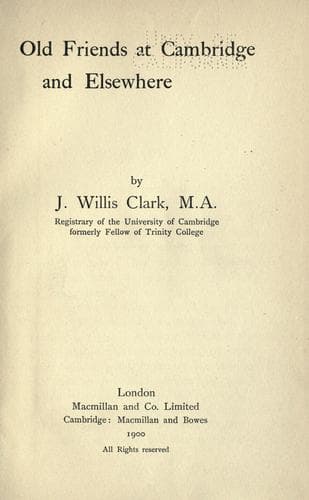
Old Friends at Cambridge and ElsewhereClark, John Willis
History
Old Friends at Cambridge and Elsewhere
Clark, John Willis
University of Cambridge -- History
It was hardly to be expected that Milnes, with his taste for the general
in literature rather than the particular, would achieve distinction in
the Cambridge of 1830. We have seen how Thirlwall disposed of his
classical aspirations, and in mathematics he fared no better. He read
hard, and hoped for distinction in the college examination. But he had
overtaxed his energies; his health gave way, and he was forced to give
up work altogether for some days. Happily, the benefit a man derives
from his three years at a university need not be measured by his
honours, and we may be sure that the experience of men and books that
Milnes gained there was of greater service to him than a high place in
any Tripos would have been. He roamed in all directions over the fields
of knowledge; phrenology, anatomy, geology, political economy,
metaphysics, by turns engaged his attention; he dabbled in periodical
literature; he acted Beatrice in _Much Ado about Nothing_, and Mrs
Malaprop in _The Rivals_; he made an excursion in a balloon with the
celebrated aeronaut, Mr Green; he wrote two prize-poems, _Timbuctoo_ and
_Byzantium_, but only to be beaten by Tennyson and Kinglake; he obtained
a second prize for an English declamation, and a first prize for an
English essay, _On the Homeric Poems_; he became a member of the club
known as ‘The Apostles,’ in which he maintained a kindly interest to the
end of his life; and last, but by no means least, he was a constant
speaker at the Union.
It is impossible, at a distance of just sixty years, to form an exact
estimate of the success of Milnes in those debates. But that it was
something more than ordinary, is, we think, certain; for otherwise he
would not have ventured to present himself at the Oxford Union in
December 1829, in the character of a self-selected missionary, who hoped
to carry light and leading into the dark places of the sister
University. As this expedition has been twice described by Milnes
himself, first in a letter to his mother soon after his return to
Cambridge, and secondly in a speech at the opening of the new building
of the Cambridge Union Society in 1866; and also, more or less fully, by
four of his contemporaries, Sir Francis Doyle, Mr Gladstone, Cardinal
Manning, and Dean Blakesley, it is clear that it was regarded by himself
and his friends, both at the time and afterwards, as something uncommon
and remarkable, and we feel sure that we shall be excused if we try to
give a connected narrative of what really took place.
Public-domain text, read in full here on John Shaqi.
Reviews
Reviews
No reviews yet
Be the first to share your thoughts on this work.
Elsewhere in the archive
Join the Discussion
Join the discussion
Sign in to leave a comment or review.
Sign InorCreate an account