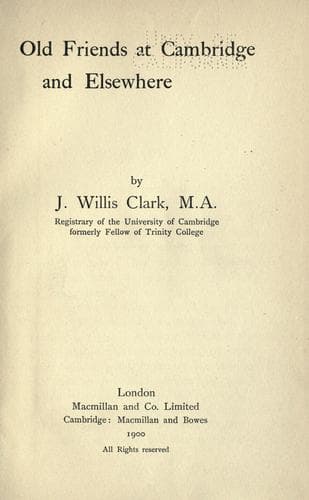
Old Friends at Cambridge and ElsewhereClark, John Willis
History
Old Friends at Cambridge and Elsewhere
Clark, John Willis
University of Cambridge -- History
Doyle had ‘brought forward a motion at the Oxford Union that Shelley was
a greater poet than Byron[79].’ According to Blakesley, ‘the respective
moral tendency of the writings of Shelley and Byron[80]’ was the subject
under debate. Doyle states that he acted ‘under Cambridge influences’;
and that his motion was ‘an echo of Cambridge thought and feeling,’
words which probably refer to the then recent reprint of Shelley’s
_Adonais_ at Cambridge. The debate, he proceeds, ‘was attended by three
distinguished members of the Cambridge Union, Arthur Hallam, Richard
Milnes, and Sunderland’; or, to use the words of what may be called his
second account, taken from a lecture on Wordsworth delivered forty-three
years afterwards, ‘friends of mine at Cambridge took the matter up and
appeared suddenly on the scene of action.’ That this was the true state
of the case, and that there was little or no premeditation about the
excursion, is made still clearer by Milnes’ first account. After
mentioning that he had been to Oxford, he proceeds:
‘I wanted much to see the place and the men, and had no objection to
speak in their society; so, as they had a good subject for debate (the
comparative merits of Shelley and Byron), and Sunderland and Hallam were
both willing to go—and the Master, when he heard what was our purpose,
very kindly gave us an _Exeat_—we drove manfully through the snow,
arriving in time to speak that evening....
‘Sunderland spoke first after Doyle, who opened, then Hallam, then some
Oxonians, and I succeeded. The contrast from our long, noisy, shuffling,
scraping, talking, vulgar, ridiculous-looking kind of assembly, to a
neat little square room, with eighty or ninety young gentlemen, sprucely
dressed, sitting on chairs or lounging about the fire-place, was enough
to unnerve a more confident person than myself. Even the brazen
Sunderland was somewhat awed, and became tautological, and spoke what we
should call an inferior speech, but which dazzled his hearers. Hallam,
as being among old friends, was bold, and spoke well. I was certainly
nervous, but, I think, pleased my audience better than I pleased
myself[81].’
In his second account, written thirty-six years afterwards, Milnes gives
greater prominence to the Union Society than, we think, is consistent
with the facts. It might easily be argued, after reading it, that the
three Cambridge undergraduates had been selected by the Society to
represent it. This exaggeration of the part played by the Union was
perhaps only natural on an occasion when the speaker must have felt
almost bound to magnify the influence of that Society on all departments
of Cambridge life. After mentioning Arthur Hallam and Sunderland, he
says:
Public-domain text, read in full here on John Shaqi.
Reviews
Reviews
No reviews yet
Be the first to share your thoughts on this work.
Elsewhere in the archive
Join the Discussion
Join the discussion
Sign in to leave a comment or review.
Sign InorCreate an account