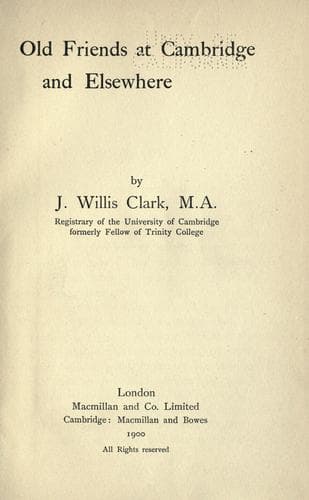
Old Friends at Cambridge and ElsewhereClark, John Willis
History
Old Friends at Cambridge and Elsewhere
Clark, John Willis
University of Cambridge -- History
We have dwelt on Milnes’s early years at some length, because their
history throws considerable light on his subsequent career, and accounts
for most of the difficulties that he experienced when he made his first
entrance into London society. ‘Conceive the man,’ said Carlyle: ‘a most
bland-smiling, semi-quizzical, affectionate, high-bred, Italianised
little man, who has long olive-blonde hair, a dimple, next to no chin,
and flings his arm round your neck when he addresses you in public
society!’ If the rough Scotch moralist was not in an unusually bad
humour when he wrote these words, it is not to be wondered at that
Milnes was regarded for a time as a dangerous person, ‘anxious to
introduce foreign ways and fashions into the conservative fields of
English life.’ But this dislike of him was very transient, and in less
than a year after his return to England he had ‘made a conquest of the
social world.’ That he was still looked upon as an oddity seems certain,
and even his intimate friend Charles Buller could exclaim: ‘I often
think how puzzled your Maker must be to account for your conduct;’ but
people soon became willing to accept him on his own terms for the sake
of his wit and brilliancy, and, we may add, of his kind heart. Some
nicknames that survived long after their application had lost its point,
are worth remembering as illustrations of what was once thought of him;
perhaps still more for the sake of the letter which Sydney Smith wrote
on being accused, quite groundlessly, of having invented them.
‘DEAR MILNES,—Never lose your good temper, which is one of your best
qualities, and which has carried you hitherto safely through your
startling eccentricities. If you turn cross and touchy, you are a lost
man. No man can combine the defects of opposite characters. The names of
“Cool of the evening,” “London Assurance,” and “In-I-go Jones,” are, I
give you my word, not mine. They are of no sort of importance; they are
safety-valves, and if you could by paying sixpence get rid of them, you
had better keep your money. You do me but justice in acknowledging that
I have spoken much good of you. I have laughed at you for those follies
which I have told you of to your face; but nobody has more readily and
more earnestly asserted that you are a very agreeable, clever man, with
a very good heart, unimpeachable in all the relations of life, and that
you amply deserve to be retained in the place to which you had too
hastily elevated yourself by manners unknown to our cold and phlegmatic
people. I thank you for what you say of my good-humour. Lord Dudley,
when I took leave of him, said to me: “You have been laughing at me for
the last seven years, and you never said anything that I wished unsaid.”
This pleased me.
‘Ever yours,
‘SYDNEY SMITH[86].’
Public-domain text, read in full here on John Shaqi.
Reviews
Reviews
No reviews yet
Be the first to share your thoughts on this work.
Elsewhere in the archive
Join the Discussion
Join the discussion
Sign in to leave a comment or review.
Sign InorCreate an account