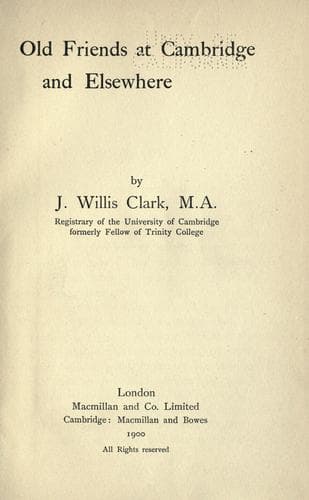
Old Friends at Cambridge and ElsewhereClark, John Willis
History
Old Friends at Cambridge and Elsewhere
Clark, John Willis
University of Cambridge -- History
When we read that Milnes ‘made a conquest of society,’ it must not be
supposed that he was a mere pleasure-seeker. On the contrary, as Mr Reid
says in another place, ‘he had too great a reverence for what was good
and pure and true, too consuming a desire to hold his own with the best
intellects of his time, and, above all, too deep a sympathy with the
suffering and the wronged to allow him to fall a victim to these
temptations.’ From the first, then, he ‘sought to combine the world of
pleasure and the world of intellect.’ A list of his friends would
contain the names of the best-known men of the day, but, at the same
time, men who had but little in common: Carlyle, Sterling, Maurice,
Spedding, Thackeray, Tennyson, Landor, Hallam, Rogers, Macaulay, Sydney
Smith. ‘He became an intimate member of circles differing so widely from
each other as those of Lansdowne House, Holland House, Gore House, and
the Sterling Club’; and as a host he was notorious for mingling together
the most discordant social elements. Disraeli sketched him in _Tancred_
under a disguise so thin that nobody could fail to penetrate it:
‘Mr Vavasour saw something good in everybody and everything, which is
certainly amiable, and perhaps just, but disqualifies a man in some
degree for the business of life, which requires for its conduct a
certain degree of prejudice. Mr Vavasour’s breakfasts were renowned.
Whatever your creed, class, or merit—one might almost add, your
character—you were a welcome guest at his matutinal meal, provided you
were celebrated. That qualification, however, was rigidly enforced. He
prided himself on figuring as the social medium by which rival
reputations became acquainted, and paid each other in his presence the
compliments which veiled their ineffable disgust’ (vol. i. p. 337).
When some one asked if a celebrated murderer had been hanged, the reply
he got was: ‘I hope so, or Richard will have him at his breakfast-table
next Thursday;’ and Thirlwall, when his friend was on the brink of
marriage, thus alludes to past felicity:
‘It is very likely, nay certain, that you will still collect agreeable
people about your wife’s breakfast-table; but can I ever sit down there
without the certainty that I shall meet with none but respectable
persons? It may be an odd thing for a Bishop to lament, but I cannot
help it’ (vol. i. p. 448).
After all it seems probable that Milnes himself, and not the lion of the
hour, was the chief attraction at those parties. He delighted in the
best sort of conversation—that which he called ‘the rapid counterplay
and vivid exercise of combined intelligences,’ and he did his best to
revive the practice of that almost forgotten art—_l’art de causer_. As
Mr Reid says:
Public-domain text, read in full here on John Shaqi.
Reviews
Reviews
No reviews yet
Be the first to share your thoughts on this work.
Elsewhere in the archive
Join the Discussion
Join the discussion
Sign in to leave a comment or review.
Sign InorCreate an account