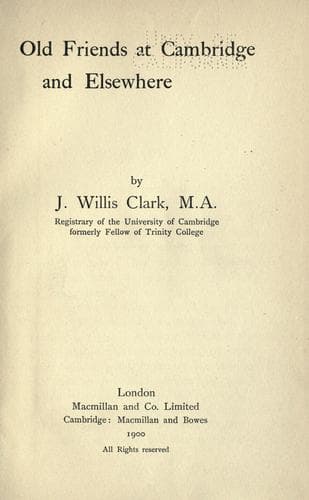
Old Friends at Cambridge and ElsewhereClark, John Willis
History
Old Friends at Cambridge and Elsewhere
Clark, John Willis
University of Cambridge -- History
‘How brilliant and amusing he was over the dinner-table or the
breakfast-table was known to all his friends. Overflowing with
information, his mind was lightened by a bright wit, whilst his immense
stores of appropriate anecdotes enabled him to give point and colour to
every topic which was brought under discussion’ (vol. i. p. 189).
At the same time he did not fall into the fatal error of taking the talk
into his own hands, and delivering a monologue, as too many social
celebrities have done before and since. He had the happy art of making
his guests talk, while he listened, and threw in a remark from time to
time, to give new life when the conversation seemed to flag. Carlyle, in
a letter written to his wife during his first visit to Fryston, gives us
a lifelike portrait of Milnes when thus engaged:
‘Richard, I find, lays himself out while in this quarter to do
hospitalities, and of course to collect notabilities about him, and play
them off one against the other. I am his trump-card at present. The
Sessions are at Pontefract even now, and many lawyers there. These last
two nights he has brought a trio of barristers to dine, producing
champagne, &c.... Last night our three was admitted to be a kind of
failure, three greater blockheads ye wadna find in Christendee. Richard
had to exert himself; but he is really dexterous, the villain. He pricks
you with questions, with remarks, with all kinds of fly-tackle to make
you bite, does generally contrive to get you into some sort of speech.
And then his good humour is extreme; you look in his face and forgive
him all his tricks’ (vol. i. p. 256).
As a pendant to this we will quote Mr Forster’s description of Milnes
and Carlyle together:
‘Monckton Miles came yesterday and left this morning—a pleasant,
companionable little man—delighting in paradoxes, but good-humoured
ones; defending all manner of people and principles in order to provoke
Carlyle to abuse them, in which laudable enterprise he must have
succeeded to his heart’s content, and for a time we had a most amusing
evening, reminding me of a naughty boy rubbing a fierce cat’s tail
backwards, and getting in between furious growls and fiery sparks. He
managed to avoid the threatened scratches’ (vol. i. p. 387).
Milnes entered Parliament in 1837 as Conservative member for Pontefract.
His friends were rather surprised at his selection of a party, for even
then his views on most subjects were decidedly Liberal. Thirlwall, for
instance, wrote:
‘I can hardly bring myself now to consider you a Tory, or indeed as
belonging to a party at all; and although I am aware how difficult, and
even dangerous, it is for a public man to keep aloof from all parties,
still my first hope as well as expectation as to your political career
is that it may be distinguished by some degree of originality’ (vol. i.
p. 199).
Public-domain text, read in full here on John Shaqi.
Reviews
Reviews
No reviews yet
Be the first to share your thoughts on this work.
Elsewhere in the archive
Join the Discussion
Join the discussion
Sign in to leave a comment or review.
Sign InorCreate an account