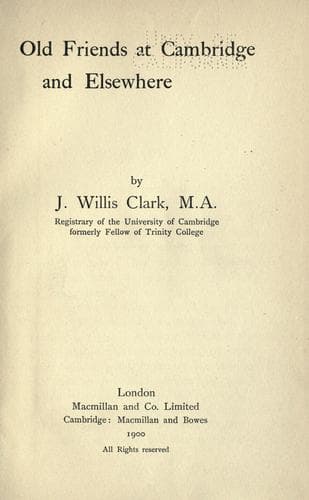
Old Friends at Cambridge and ElsewhereClark, John Willis
History
Old Friends at Cambridge and Elsewhere
Clark, John Willis
University of Cambridge -- History
Before long Milnes found a more congenial position on the opposite side
of the House. But it must not be supposed that he rushed into sudden and
rancorous opposition to his old leader. So long as Peel remained in
office, he allowed no personal considerations to interfere with his
support of him; and he steadily refused to join those who rebelled when
he announced his conversion to Free Trade. Meanwhile, his interest in
the burning question of the day being little more than formal, he turned
his attention to a social question in which he had long been interested,
and introduced a Bill for the establishment of reformatories for
juvenile offenders. Among the many combinations of opposite tastes and
tendencies with which Milnes was fond of startling the world, could one
more curious be imagined than this—the literary exquisite and the
criminal unwashed? But in fact this is only a single instance out of
many which could be produced to show that the cynical selfishness he
affected was only a mask which hid his real nature; perhaps assumed for
the sake of concealing from his left hand what his right hand was doing
so well. The proposal, we are told, ‘was scoffed at by many politicians
of eminence when it was first put forward.’ But Milnes was not to be
daunted by rebuffs, and ‘he persevered with his proposal, until he had
the great happiness of seeing reformatories established under the
sanction of the law, and of becoming himself the president of the first
and greatest of these noble institutions, that at Redhill.’ His very
genuine sympathy with the poor and the unfortunate, especially when
young, is testified to by one of his intimate friends, Miss Nightingale:
‘His brilliancy and talents in tongue or pen—whether political, social,
or literary—were inspired chiefly by good-will towards man; but he had
the same voice and manners for the dirty brat as he had for a duchess,
the same desire to give pleasure and good. Once, at Redhill, where we
were with a party, and the chiefs were explaining to us the system in
the court-yard, a mean, stunted, villainous-looking little fellow crept
across the yard (quite out of order, and by himself), and stole a dirty
paw into Mr Milnes’s hand. Not a word passed; the boy stayed quite quiet
and quite contented if he could but touch his benefactor who had placed
him there. He was evidently not only his benefactor, but his friend’
(vol. ii. p. 7).
Public-domain text, read in full here on John Shaqi.
Reviews
Reviews
No reviews yet
Be the first to share your thoughts on this work.
Elsewhere in the archive
Join the Discussion
Join the discussion
Sign in to leave a comment or review.
Sign InorCreate an account